"/><stop offset="1" stop-color="rgb(96, 110, 234)"/></linearGradient><linearGradient id="W2X9EKAmH-2169866396-linear-gradient" x1="0.49751243781094523" x2="0.5024875621890548" y1="0" y2="1"><stop offset="0" stop-color="rgb(120, 70, 175)"/><stop offset="1" stop-color="rgb(96, 110, 234)"/></linearGradient></defs><g fill="transparent" height="6.667790173290786px" id="WxDMP_wo5" transform="translate(0 -0.335)" width="40.000237191183544px"><path d="M 0 6.667 L 0 0 L 40 0 L 40 6.667 Z" fill="transparent" height="6.666666666666666px" id="sESj6aK3L" width="40px"/><path d="M 5.133 1.25 L 5.133 4.583 L 2.933 5.833 L 0.733 4.583 L 0.733 2.083 L 2.933 0.833 L 2.933 0 L 0 1.667 L 0 5 L 2.933 6.667 L 5.867 5 L 5.867 1.667 Z" fill="url(%23SjiByaea2-2169866396-linear-gradient)" height="6.666666666666666px" id="SjiByaea2" width="5.866783625730994px"/><path d="M 0.733 3.333 L 0.733 2.5 L 1.467 2.083 L 1.467 1.25 L 0 2.083 L 0 3.75 L 1.467 4.583 L 2.933 3.75 L 2.933 0.417 L 2.2 0 L 2.2 3.333 L 1.467 3.75 Z" fill="url(%23W2X9EKAmH-2169866396-linear-gradient)" height="4.583333333333334px" id="W2X9EKAmH" transform="translate(1.467 0.417)" width="2.9334035087719315px"/><path d="M 0 3.985 L 0 0 L 1.547 0 C 1.864 0 2.128 0.045 2.342 0.134 C 2.559 0.22 2.733 0.346 2.864 0.513 C 2.994 0.681 3.087 0.883 3.142 1.12 C 3.201 1.357 3.231 1.628 3.231 1.931 C 3.231 2.239 3.203 2.517 3.148 2.766 C 3.097 3.014 3.008 3.23 2.881 3.413 C 2.755 3.596 2.585 3.738 2.371 3.839 C 2.158 3.936 1.891 3.985 1.571 3.985 Z M 0.818 3.308 L 1.524 3.308 C 1.709 3.308 1.86 3.273 1.974 3.203 C 2.089 3.133 2.176 3.036 2.235 2.911 C 2.298 2.783 2.34 2.637 2.36 2.474 C 2.383 2.307 2.395 2.126 2.395 1.931 C 2.395 1.745 2.383 1.575 2.36 1.424 C 2.336 1.268 2.292 1.136 2.229 1.027 C 2.17 0.914 2.083 0.829 1.968 0.77 C 1.858 0.708 1.709 0.677 1.524 0.677 L 0.818 0.677 Z" fill="rgb(255, 255, 255)" height="3.984970760233911px" id="pQ_u90pAO" transform="translate(8.945 1.452)" width="3.231064327485413px"/><path d="M 0 2.999 L 0 0.07 L 0.789 0.07 L 0.789 0.414 C 0.856 0.364 0.939 0.311 1.038 0.257 C 1.136 0.198 1.243 0.146 1.358 0.099 C 1.476 0.049 1.589 0.016 1.696 0 L 1.696 0.753 C 1.593 0.768 1.484 0.795 1.37 0.834 C 1.255 0.869 1.146 0.908 1.044 0.951 C 0.945 0.994 0.86 1.033 0.789 1.068 L 0.789 2.999 Z" fill="rgb(255, 255, 255)" height="2.9989356725146212px" id="HUQJBJ1t7" transform="translate(12.803 2.437)" width="1.6956725146198863px"/><path d="M 1.387 3.057 C 1.051 3.057 0.781 3.003 0.575 2.894 C 0.373 2.785 0.227 2.618 0.136 2.392 C 0.045 2.163 0 1.867 0 1.505 C 0 1.155 0.047 0.871 0.142 0.653 C 0.237 0.432 0.387 0.268 0.593 0.163 C 0.798 0.054 1.063 0 1.387 0 C 1.715 0 1.98 0.054 2.182 0.163 C 2.387 0.268 2.537 0.432 2.632 0.653 C 2.731 0.871 2.78 1.155 2.78 1.505 C 2.78 1.867 2.735 2.163 2.644 2.392 C 2.553 2.618 2.405 2.785 2.2 2.894 C 1.998 3.003 1.727 3.057 1.387 3.057 Z M 1.387 2.415 C 1.553 2.415 1.678 2.386 1.761 2.328 C 1.844 2.266 1.899 2.168 1.927 2.036 C 1.958 1.9 1.974 1.723 1.974 1.505 C 1.974 1.291 1.956 1.122 1.921 0.998 C 1.885 0.869 1.826 0.778 1.743 0.723 C 1.66 0.669 1.541 0.642 1.387 0.642 C 1.237 0.642 1.118 0.669 1.032 0.723 C 0.949 0.778 0.889 0.869 0.854 0.998 C 0.818 1.122 0.8 1.291 0.8 1.505 C 0.8 1.723 0.814 1.9 0.842 2.036 C 0.873 2.168 0.931 2.266 1.014 2.328 C 1.097 2.386 1.221 2.415 1.387 2.415 Z" fill="rgb(255, 255, 255)" height="3.057263157894756px" id="EIrO2_THA" transform="translate(14.828 2.444)" width="2.7804678362573156px"/><path d="M 0 4.224 L 0 0.064 L 0.782 0.064 L 0.788 0.251 C 0.844 0.216 0.913 0.179 0.996 0.14 C 1.083 0.101 1.176 0.068 1.275 0.041 C 1.373 0.014 1.47 0 1.565 0 C 1.964 0 2.251 0.126 2.425 0.379 C 2.599 0.628 2.686 1.007 2.686 1.517 C 2.686 1.883 2.642 2.178 2.555 2.404 C 2.468 2.629 2.328 2.795 2.134 2.9 C 1.945 3.005 1.694 3.057 1.381 3.057 C 1.282 3.057 1.176 3.049 1.061 3.034 C 0.947 3.018 0.856 3.003 0.788 2.987 L 0.788 4.224 Z M 1.257 2.41 C 1.415 2.41 1.539 2.377 1.63 2.31 C 1.721 2.244 1.784 2.145 1.82 2.013 C 1.86 1.877 1.879 1.706 1.879 1.499 C 1.879 1.181 1.834 0.961 1.743 0.84 C 1.656 0.716 1.529 0.653 1.364 0.653 C 1.3 0.653 1.233 0.661 1.162 0.677 C 1.091 0.692 1.022 0.712 0.954 0.735 C 0.887 0.758 0.832 0.782 0.788 0.805 L 0.788 2.369 C 0.836 2.373 0.903 2.38 0.99 2.392 C 1.081 2.404 1.17 2.41 1.257 2.41 Z" fill="rgb(255, 255, 255)" height="4.2241871345029445px" id="azBGUfGeg" transform="translate(18.207 2.444)" width="2.6856140350876103px"/><path d="M 0 2.929 L 0 2.27 L 1.346 0.688 L 0 0.688 L 0 0 L 2.384 0 L 2.384 0.636 L 1.026 2.24 L 2.389 2.24 L 2.389 2.929 Z" fill="rgb(255, 255, 255)" height="2.9289239766081856px" id="GMxU4HuKZ" transform="translate(21.361 2.507)" width="2.3893567251462002px"/><path d="M 1.387 3.057 C 1.051 3.057 0.781 3.003 0.575 2.894 C 0.374 2.785 0.227 2.618 0.136 2.392 C 0.045 2.163 0 1.867 0 1.505 C 0 1.155 0.047 0.871 0.142 0.653 C 0.237 0.432 0.387 0.268 0.593 0.163 C 0.798 0.054 1.063 0 1.387 0 C 1.715 0 1.98 0.054 2.182 0.163 C 2.387 0.268 2.537 0.432 2.632 0.653 C 2.731 0.871 2.78 1.155 2.78 1.505 C 2.78 1.867 2.735 2.163 2.644 2.392 C 2.553 2.618 2.405 2.785 2.2 2.894 C 1.998 3.003 1.727 3.057 1.387 3.057 Z M 1.387 2.415 C 1.553 2.415 1.678 2.386 1.761 2.328 C 1.844 2.266 1.899 2.168 1.927 2.036 C 1.958 1.9 1.974 1.723 1.974 1.505 C 1.974 1.291 1.956 1.122 1.921 0.998 C 1.885 0.869 1.826 0.778 1.743 0.723 C 1.66 0.669 1.541 0.642 1.387 0.642 C 1.237 0.642 1.118 0.669 1.031 0.723 C 0.949 0.778 0.889 0.869 0.854 0.998 C 0.818 1.122 0.8 1.291 0.8 1.505 C 0.8 1.723 0.814 1.9 0.842 2.036 C 0.874 2.168 0.931 2.266 1.014 2.328 C 1.097 2.386 1.221 2.415 1.387 2.415 Z" fill="rgb(255, 255, 255)" height="3.057263157894756px" id="hVOAJWBR_" transform="translate(24.216 2.444)" width="2.7804678362571735px"/><path d="M 0 2.993 L 0 0.064 L 0.789 0.064 L 0.789 0.251 C 0.852 0.212 0.929 0.175 1.02 0.14 C 1.111 0.101 1.205 0.068 1.304 0.041 C 1.407 0.014 1.506 0 1.601 0 C 1.877 0 2.091 0.049 2.241 0.146 C 2.395 0.239 2.504 0.395 2.567 0.613 C 2.63 0.827 2.662 1.114 2.662 1.476 L 2.662 2.993 L 1.867 2.993 L 1.867 1.517 C 1.867 1.315 1.855 1.153 1.832 1.033 C 1.808 0.908 1.763 0.819 1.695 0.764 C 1.628 0.71 1.529 0.683 1.399 0.683 C 1.328 0.683 1.253 0.69 1.174 0.706 C 1.099 0.718 1.026 0.735 0.954 0.758 C 0.887 0.782 0.832 0.805 0.789 0.828 L 0.789 2.993 Z" fill="rgb(255, 255, 255)" height="2.993099415204677px" id="k6aC5HsJY" transform="translate(27.596 2.444)" width="2.6617543859649118px"/><path d="M 1.316 3.057 C 0.988 3.057 0.727 3.003 0.533 2.894 C 0.344 2.785 0.207 2.62 0.124 2.398 C 0.042 2.176 0 1.898 0 1.564 C 0 1.202 0.051 0.906 0.154 0.677 C 0.261 0.447 0.415 0.278 0.616 0.169 C 0.818 0.056 1.067 0 1.363 0 C 1.802 0 2.132 0.109 2.353 0.327 C 2.579 0.545 2.691 0.889 2.691 1.359 L 2.656 1.791 L 0.794 1.791 C 0.798 2.009 0.844 2.172 0.931 2.281 C 1.018 2.39 1.168 2.445 1.381 2.445 C 1.504 2.445 1.638 2.443 1.784 2.439 C 1.931 2.431 2.075 2.423 2.217 2.415 C 2.363 2.408 2.488 2.4 2.591 2.392 L 2.609 2.935 C 2.51 2.95 2.385 2.968 2.235 2.987 C 2.085 3.007 1.929 3.022 1.767 3.034 C 1.609 3.049 1.458 3.057 1.316 3.057 Z M 0.794 1.295 L 1.903 1.295 C 1.903 1.031 1.86 0.846 1.773 0.741 C 1.69 0.636 1.553 0.583 1.363 0.583 C 1.178 0.583 1.035 0.638 0.937 0.747 C 0.842 0.856 0.794 1.039 0.794 1.295 Z" fill="rgb(255, 255, 255)" height="3.0572631578947593px" id="HWRgQ4Zqc" transform="translate(30.819 2.443)" width="2.691461988304269px"/><path d="M 0 3.985 L 1.031 0 L 2.46 0 L 3.486 3.985 L 2.668 3.985 L 2.442 3.18 L 1.026 3.18 L 0.812 3.985 Z M 1.156 2.532 L 2.324 2.532 L 1.867 0.653 L 1.619 0.653 Z" fill="rgb(255, 255, 255)" height="3.984970760233911px" id="FKU8sIkPM" transform="translate(35.19 1.452)" width="3.48608187134505px"/><path d="M 0 3.985 L 0 0 L 0.818 0 L 0.818 3.985 Z" fill="rgb(255, 255, 255)" height="3.984970760233918px" id="dMjn7rx8Q" transform="translate(39.182 1.452)" width="1px"/></g></svg>)

Key Takeaways
Platform vendors’ AI triage agents are valuable but limited. They speed up enrichment but can’t do a consistently thorough job on every investigation.
Real analysts think beyond silos. Human-driven investigators draw on multiple security and business systems to uncover the full context behind an alert, something single-platform AI can’t do.
Dropzone AI bridges the gap. Acting as a dedicated AI SOC analyst, Dropzone AI correlates data across all tools and systems and reasons through investigations to completion.
Cross-tool reasoning reduces blind spots, accelerates investigations, and provides human analysts with confidence in every conclusion.
Introduction
AI is no longer an experiment in cybersecurity. It’s become a standard feature. Nearly every major vendor now offers built-in AI, typically an AI-driven triage capability designed to accelerate investigations within their own platform. These platform-native agents bring real value:
Speed up alert handling
Reduce manual effort
Introduce automation into workflows that were once entirely human-driven
But there’s a catch. Each of these platform-native agents is confined to the platform for which it was designed. They can only see and act on the data within that one platform. In practice, this means investigations lack critical context that is scattered across other tools and systems that the built-in triage agent doesn’t use.
And that’s the real challenge for today’s SOCs. Modern threats don’t respect platform boundaries, and neither should investigations. Security teams require a means to connect signals across various tools, accounts, and business systems to gain a complete view. That’s where a dedicated AI SOC analyst comes in, not tied to one vendor’s stack, but built to work like a human analyst who pulls evidence from everywhere it matters and reasons through investigations to their completion.
Why Platform-Native AI Isn’t Enough
The strength of platform-native AI lies in its focus on specific tasks. These built-in AI agents are optimized to automate investigations within a single platform or with select integration partners, using the data they know best. That focus improves speed, but it also creates a significant limitation: they can’t see beyond their own walls. Each investigation remains bound by the visibility of that one vendor’s platform, leaving blind spots wherever other tools or systems hold critical context.
Real-world investigations don’t work that way. Threats rarely announce themselves neatly inside a single platform. Common investigation scenarios include:
A suspicious login that needs cross-checking against travel schedules
File access patterns that require correlation with collaboration tool activity
Elevated permissions that must be verified against ticketing systems like Jira
Without that context, it’s far too easy for an investigation to stop short or, worse, to miss the real threat entirely.
That’s why vendor-native AI, while useful, isn’t sufficient on its own. Security operations demand a broader view, one that connects evidence across multiple platforms and business systems. Without it, investigations risk being fast but incomplete.
To put it bluntly: An AI triage agent that only automates 60% of an investigation but requires a human to finish the remainder isn’t transformative. It’s nice, to be sure. But it’s not going to solve the alert overload problem.
How Real Analysts Investigate
When a human analyst approaches an investigation, they don’t stop at the first alert. Instead, they follow the trail across multiple systems to build a complete picture of what’s happening.
Security tools provide the initial signals:
Identity logs from Okta or Microsoft Entra
Endpoint detections from Microsoft Defender
Cloud activity from Google Security Operations
However, those alone are rarely enough to confirm whether an alert is malicious or benign.
That’s where business systems come in:
Check calendars to see if a login from another country lines up with legitimate travel
Look at Google Drive or SharePoint to understand whether unusual file activity is part of an ongoing project or a sign of exfiltration
Scan Slack or Teams conversations for clues about whether a user’s account is being used legitimately or abused
Turn to Jira to verify whether elevated permissions access was requested and approved
This cross-system approach matters because context is everything. A login, a file transfer, or a permission change can all appear suspicious in isolation. Only by layering evidence from across the environment can analysts distinguish between false alarms and true threats. In practice, this is what makes human investigation so effective, and it’s the model that a dedicated AI SOC analyst is designed to replicate.
Dropzone AI’s Difference: The Dedicated AI SOC Analyst
What sets Dropzone AI apart is its ability to think and act like a seasoned analyst, not one limited to a single platform, but one who knows how to pull context from across the entire environment. Instead of stopping at an endpoint alert or an identity log, Dropzone AI’s AI SOC analyst reaches into the security and business systems you have implemented, weaving together evidence that reveals the full scope of an incident, just like a human analyst would.
Its investigations aren’t just automated checklists. Dropzone AI uses recursive reasoning, continually gathering and reassessing context until it can reach a well-supported conclusion. That process dramatically reduces the risk of false negatives, the most dangerous type of error where a genuine threat is mistaken for benign activity. And it’s engineered to provide reliable results you can trust. Read about Dropzone AI’s QA program.
The outcome is a decision-ready report that feels like it was crafted by an experienced human analyst:
Clear reasoning
Evidence laid out step by step
A conclusion that the SOC team can act on immediately
By delivering investigations with the depth and consistency of a trained professional, Dropzone AI doesn’t just automate triage; it also guarantees that investigations are conducted with the same level of expertise. It provides the confidence and clarity teams need to move faster without sacrificing accuracy.
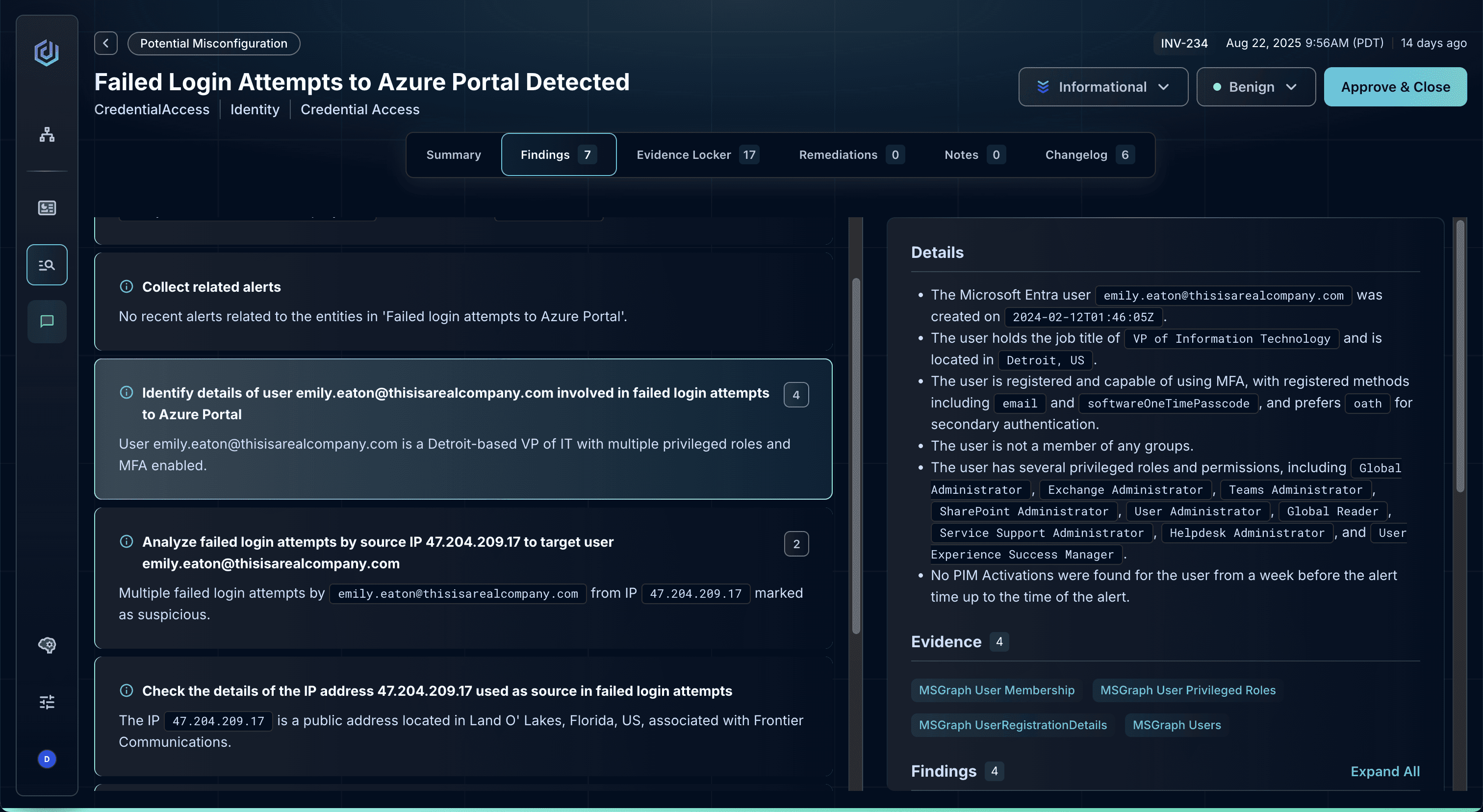
The Dropzone AI system replicates the investigative techniques of elite analysts.
Why This Complements Platform-Native AI
The goal isn’t to replace vendor AI, but to complement it. Think of platform-native AI as improving visibility within a single room, while Dropzone AI opens the doors and windows to see the entire house. Together, they provide a clearer, more complete picture.
Built-in AI guarantees speed and automation locally
Dropzone AI connects the dots across security and business systems, delivering the context that transforms triage into true investigation
It’s not an either/or choice. The strongest SOCs benefit from both vendor AI for faster platform-level insights and Dropzone AI for cross-tool reasoning, providing that nothing important is missed.
Benefits to Security Teams
A dedicated AI SOC analyst delivers benefits that go beyond convenience. It reshapes how security teams operate:
Thoroughness - Investigations are automated end-to-end across the stack with the investigative process replicating the techniques of elite analysts. Read about the OSCAR methodology that Dropzone AI’s AI SOC analyst uses.
Expanded coverage - AI SOC analysts can investigate alerts from multiple sources, including cloud, email, identity, endpoint, and other security tools. Additionally, by pulling context from multiple sources, the AI SOC analyst eliminates blind spots that arise when investigations remain confined to a single platform. Alerts are no longer viewed in isolation but understood within the broader environment, making it harder for threats to slip through unnoticed.
Confidence - With greater context comes confidence. Analysts receive reports backed by clear evidence and sound reasoning, reducing the uncertainty that often hinders decision-making. They can move forward knowing the conclusions are thorough and reliable and have left no metaphorical stone unturned.
Efficiency - And finally, there’s efficiency. By delivering results that humans can trust, an AI SOC analyst carries the weight of repetitive triage, leaving humans free to apply their expertise where it counts most on the escalated investigations that demand human attention.
Beyond Built-In AI Triage: What SOCs Really Need
The future of security operations won’t be won by piling on more platform-native triage agents. These tools play their part, but they stop short of solving the bigger challenge: connecting the dots across the entire environment. What SOCs really need is an analyst who never sleeps, never tires, and can pull context from every corner of the stack.
A dedicated AI SOC Analyst delivers precisely that. It accelerates investigations, closes the gaps left by siloed tools, and provides decision-ready reports that analysts can trust. The result is:
Faster responses
Fuller coverage
A team free to focus on the high-value work that strengthens defenses
It’s time to think beyond built-in, tool-specific AI. See how Dropzone AI’s dedicated AI SOC Analyst brings the bigger picture into focus by querying multiple sources and delivering investigations with the depth of a seasoned human analyst. Request a demo today to see how a dedicated AI SOC Analyst can amplify your SOC’s effectiveness.
" width="32px"><path d="M 10 11.4 L 0 1.4 L 1.4 0 L 10 8.6 L 18.6 0 L 20 1.4 Z" fill="rgb(0, 0, 0)" height="11.400000000000006px" id="WzVcCPzSg" transform="translate(6 10.5)" width="20px"/><path d="M 0 0 L 32 0 L 32 32 L 0 32 Z" fill="transparent" height="32px" id="JnWsCmB6z" width="32px"/></g></svg>)