No model training on customer data
Your alert data and investigative context are processed for inference only. They aren't retained to train or fine-tune foundation models.
AI SOC Investigations
Fully Contained Within the EU
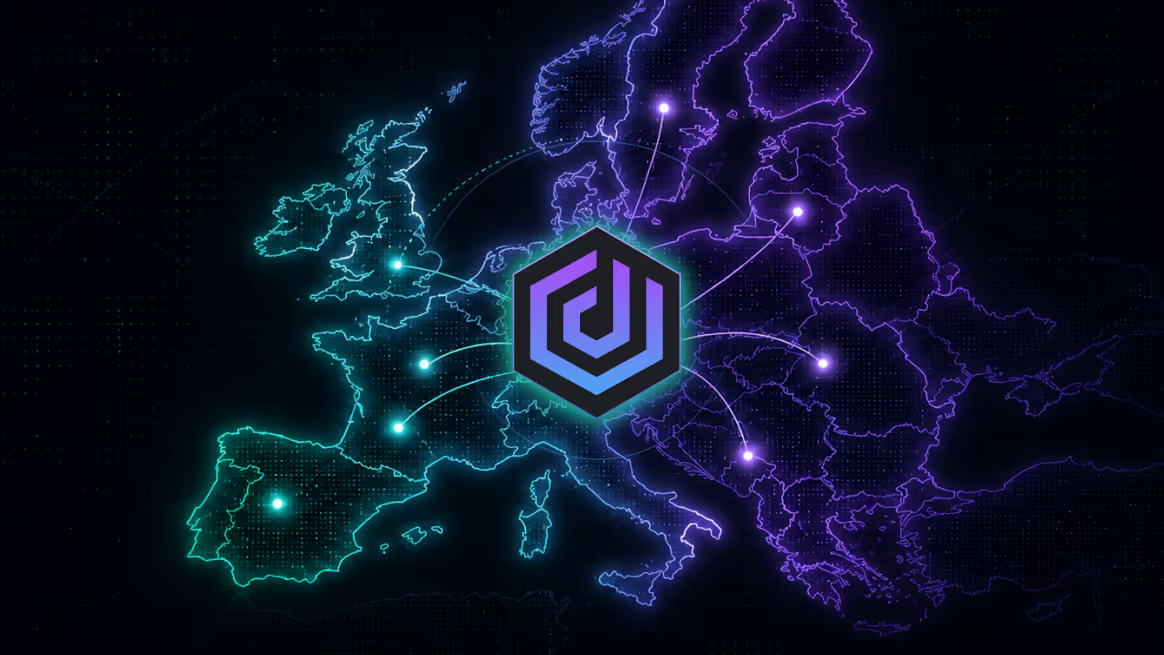
Dropzone's AI SOC Analyst processes and investigates your security alerts inside EU data-residency boundaries. No cross-border data transfers, no architectural workarounds, no compromise on response speed.
300+
deployments worldwide
90+
integrations

Gartner Cool Vendor for the Modern SOC
Dropzone's EU deployment runs alert ingestion, AI investigation, and report generation entirely inside EU cloud infrastructure. Customer investigation data isn't used to train foundation models, and access is restricted to authorised personnel. The architecture supports GDPR principles like purpose limitation and data minimisation, and aligns with EU AI Act obligations for transparency and human oversight.
No model training on customer data
Your alert data and investigative context are processed for inference only. They aren't retained to train or fine-tune foundation models.

Evidence-backed audit trail
Every investigation produces a transparent report linking conclusions to supporting evidence. Analysts can review or override outcomes at any time.
For full architecture detail, see our security and trust posture.
What EU CISOs ask before deploying an AI SOC analyst
How does Dropzone keep investigation data inside the EU?
By enforcing EU-only processing at the infrastructure level. Alert data, investigative artefacts, enrichment queries, and AI model inference all run inside EU boundaries. There aren't any cross-region model calls or hidden processing dependencies. Data residency is enforced architecturally, not just by policy.
Do the LLMs learn from our data?
No. Customer investigation data isn't used to train or fine-tune foundation models. Alert data and investigative context are processed solely for inference, aren't retained for training, and aren't shared across customers. Each deployment operates within its own data boundary.
Are investigations fully auditable?
Yes. Dropzone produces evidence-backed investigation reports built for review and compliance workflows. Every conclusion links to the underlying evidence, the queried data sources, and the reasoning steps. The leading European MSSP required investigations to be explainable, evidence-backed, and auditable from day one.
Are humans in control?
Yes. The AI SOC Analyst operates within human-defined scope, permissions, and escalation policies. It investigates and produces reports, but remediation and incident decisions stay with authorised personnel unless explicitly configured otherwise. Every investigation includes a transparent audit trail, and analysts can review or override outcomes at any time.
Can humans outside the EU access our data?
Not without explicit customer authorisation. EU deployments restrict access to authorised personnel under controlled access policies, and there's no routine access to EU customer data from non-EU locations. Access controls are enforced at the infrastructure and identity level, not just by policy.
Does any of our data leave the EU?
No. Alert data and AI investigation workflows are processed within EU infrastructure boundaries. Investigation data isn't transmitted to non-EU regions for model inference, enrichment, or analysis. Some third-party threat intelligence feeds may not offer EU-specific endpoints; you control which feeds are enabled.
How EU data residency works for AI SOC investigations
Ingest (in-region)
Alerts ingested locally inside the EU
Investigate (EU AI inference)
EU-resident model inference, authorised tool enrichment only
Report (evidence + audit trail)
Generated and stored without cross-border data movement
Alerts are ingested locally inside the EU. The AI SOC Analyst runs investigations using EU-resident model inference, pulling enrichment from your authorised tools and only when a specific alert requires it. Reports are generated and stored without moving data across borders.
Investigations operate within the integrations and permissions you configure. The AI pulls data only from approved tools and only as needed to resolve the alert in question. That's the data minimisation principle from GDPR Article 5, made operational.
Built for GDPR and the EU AI Act
GDPR: AI investigations are data processing
In a SOC, logs, alerts, identities, IP addresses, and investigation notes fall into GDPR scope when they can be linked to an identifiable person. The AI SOC Analyst is designed for purpose-limited security work: investigations stay tied to the alert, and data is pulled only to resolve that specific question.
Purpose limitation. Investigations stay tied to the security alert (Article 5(1)(b)).
Data minimisation. Collect and analyse only what's needed to reach a conclusion (Article 5(1)(c)).
Security of processing. Operate within configured integrations and permissions (supporting Article 32).
Auditability. Evidence-backed investigation reports support DPIA and Article 35 reviews.
EU AI Act: AI you can govern, not just deploy
As EU AI Act obligations roll out, the AI SOC Analyst supports the operational requirements that matter most for high-risk AI system deployment in security environments: transparent investigation outputs, evidence you can verify, and human oversight built into the workflow.
Human oversight. Analysts review outcomes and decide next steps.
Traceability. Every conclusion links to supporting evidence.
Technical documentation. Investigation reports double as audit-ready records.
Controlled integrations. Operate strictly within customer-authorised boundaries.
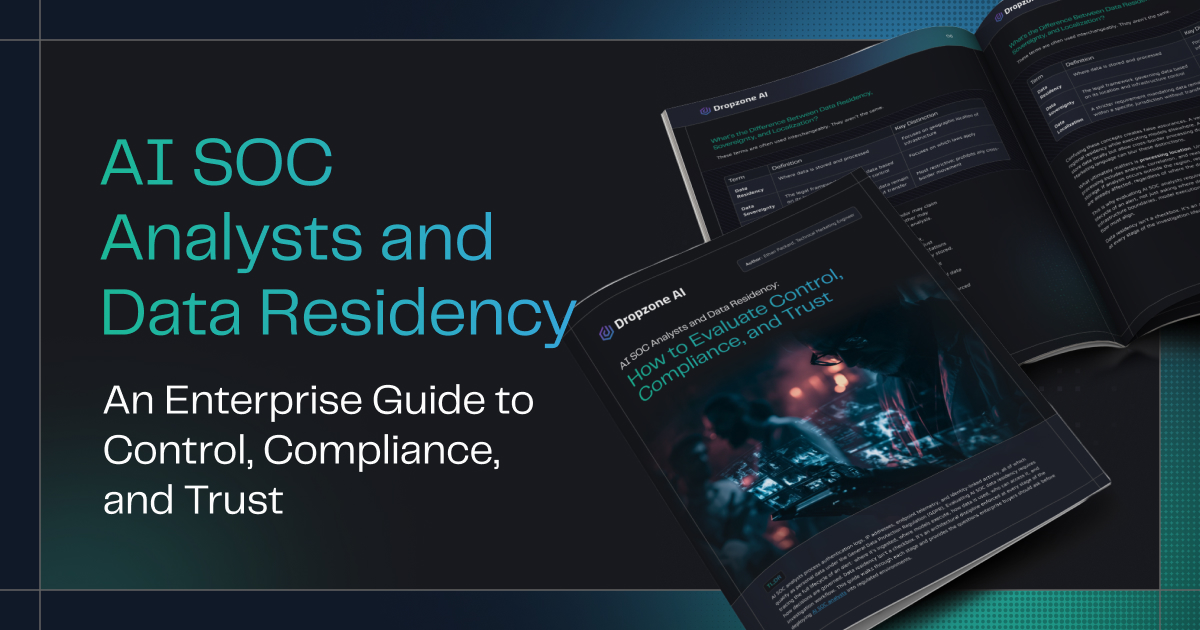
Resources for your DPIA and procurement review


"Dropzone did not replace analysts. It gave them room to operate, scale, and evolve."
90–95%
Investigation accuracy
Minutes vs. hours
Per investigation
Strict
Customer separation + EU data residency met
This European MSSP needed Tier 1 investigation capacity that could scale across more than a hundred customer environments without compromising data residency, customer separation, or analyst control. After a rigorous POC against live Microsoft Defender and Sentinel alerts, Dropzone fit into existing SOAR and case management workflows with analysts retaining full control over response actions.
Most of it does. Logs, IP addresses, authentication events, identity records, and investigation notes can be linked to an identifiable person, which brings them under GDPR scope. The AI SOC Analyst is built for purpose-limited security work: investigations stay tied to a specific alert, data is pulled only when needed to resolve that question, and outputs are evidence-backed for review
Data minimisation means collecting and processing only what's necessary. The AI SOC Analyst pulls data only from authorised integrations, only when a specific alert requires it, and only to resolve that question. Investigations don't sweep data broadly. Outputs are scoped to the alert in front of the analyst, not the broader environment.
Where investigation data is processed, where it's stored, whether any part of the workflow crosses regional boundaries, what model training does or doesn't happen, what access controls exist, and how investigations are logged and audited. Dropzone's EU deployment is designed to make each of these questions easy to answer for your DPO and DPIA reviewers.
It depends on use case and deployer. Where your deployment may fall under high-risk obligations, the AI SOC Analyst supports the operational controls that matter: human oversight, traceability, technical documentation, and bounded integrations. We'd recommend confirming classification with your legal team and your deployer-side AI governance review.
Data residency means data is physically stored and processed in a specific region. Data sovereignty adds the legal dimension: which country's laws govern access. Dropzone's EU deployment addresses residency by keeping processing and storage inside the EU. Sovereignty considerations depend on your cloud provider and jurisdiction; we'd recommend reviewing the underlying contract terms with your legal team.
Article 22 limits decisions made solely on automated processing where they have legal or similarly significant effects on individuals. The AI SOC Analyst's role is investigation, not adjudication: it gathers evidence and reasons through alerts, but human analysts retain decision authority on remediation and incident response by default. That structure aligns with how Article 22 is typically interpreted for security operations.
For most operational security work, the principles align closely: lawful basis, purpose limitation, data minimisation, security of processing. Cross-border transfer rules and supervisory authority differ. Dropzone's EU deployment supports both frameworks; UK customers should verify their specific transfer mechanism with the ICO if data flows outside the UK.
Ready to evaluate Dropzone for your EU SOC?
See how the AI SOC Analyst investigates alerts inside EU data-residency boundaries, then start the procurement conversation.






.png)
