
You've tuned the noisiest rules, raised the severity threshold, and written the playbooks, and the queue is still there at shift change. That's the normal experience of alert fatigue in a SOC, and it isn't a sign anyone did the tuning wrong.
What is alert fatigue in cybersecurity?
Alert fatigue is what happens when a security team gets more alerts than it can investigate. Past that point, alerts get closed on pattern, by what they look like instead of what the evidence says. Real threats sit in the queue behind false positives, and the analysts working the queue stop trusting it.
It's a capacity gap. A detection fires, and an analyst has to gather the context, build the timeline and reach a verdict. When the team runs out of hours before it runs out of queue, the queue wins, and it keeps winning every shift until something changes.
The gap is at investigation, not detection. Detection tools have improved for years and keep improving. Investigation has always needed an analyst to do it, which is why that's where the hours go and where the backlog builds.
Why does the queue outrun the team even after you've tuned?
Three things stack up, and tuning only touches the first.
Why do false positives dominate the queue?
Detections are tuned to catch anything that might be bad, so most of what fires turns out to be fine.
Every new tool adds its own feed of alerts, and the context that would explain an alert only gets pulled after it fires.
An analyst opens the alert, pulls the user, the host and the history, and only then learns it was the same login from the same laptop as yesterday. It was a false positive you could have called in seconds.
Why does more tooling produce more alerts?
The 2026 SANS SOC Survey found alerting and triage nearly universal, reported by close to 100 percent of respondents. Every tool in the stack alerts on what it can see, and a single event on one host can fire in the endpoint tool, the identity provider and the SIEM (security information and event management) as three separate alerts.
Correlation rules catch the combinations a detection engineer thought of in advance. The rest show up as three tickets, and the analyst has to connect them in their head.
Why does context arrive too late?
Deciding whether an alert is real means building the timeline around it, and in most SOCs a person builds it by hand from four or five different reports.
That's the part of the job that still needs a human, and it's the part that hasn't gotten any faster. Detection did. Working out what a detection means didn't, so that's exactly where the queue grows.
What does alert fatigue cost a security team?
The cost lands on SOC analysts who are already stretched thin. The 2025 ISC2 Cybersecurity Workforce Study, which surveyed 16,029 practitioners and decision-makers, found 48 percent reported feeling exhausted from trying to stay current and 47 percent said they often feel overwhelmed by the workload they're expected to bear.
It also costs the SOC its analysts. The SANS 2026 survey found meaningful work and career progression are the top retention drivers for the third year running, and compensation has fallen to fourth place.
A queue that never empties is the opposite of meaningful work, and the analysts who leave over it are usually the ones who were doing the investigating properly.
And it costs coverage. Somewhere in the alerts that got closed on pattern is the one that mattered. That risk doesn't need a breach-cost figure attached to it. Catching that alert is the reason the SOC exists.
Why do the usual fixes stall?
Most SOC managers have tried at least three of these. They work, and then they stop working, for the same reason each time.
- Tuning and suppression. Cutting the noisiest detections helps immediately, and then the next tool or the next quarter's detections restore the volume. Tuning is maintenance, and it has to be redone every time the stack changes.
- Severity thresholds. Raising the bar on what reaches an analyst moves the risk into the alerts nobody looks at. It changes what's ignored, not how much.
- SOAR playbooks. A SOAR platform (security orchestration, automation and response) runs the repeatable response for the scenarios that already have a playbook. It's a tool, and a useful one, but it can't investigate the alert nobody anticipated, which is the alert that produces the backlog.
- Hiring. Coverage grows one hire at a time, and hiring is the hard part. The SANS 2026 survey found lack of skilled staff the top operational challenge, and the ISC2 2025 finding that 57 percent of respondents got a raise of 1 to 9 percent and 20 percent got none says budgets are tight on the retention side too.
Each of these works on the count of alerts that reach an analyst. None of them changes what an analyst has to do once one arrives.
What actually reduces alert fatigue?
Four moves change what happens to an alert after it fires, and each has a named result behind it:
- Investigate every alert. When every alert gets a real investigation instead of being closed on pattern, the false positives get closed on evidence and the real threats stop hiding behind them. Assala Energy investigated 100 percent of its alerts and saw 70 percent fewer false positives and 5x faster response.
- Deliver findings instead of raw alerts. A finding arrives with the timeline, the evidence and a verdict attached, so reviewing it means making the call, not redoing the investigation. Indiana Farm Bureau gets verdicts in under 10 minutes and does 75 percent less manual investigative work.
- Let corrections persist. When an analyst says an alert is normal here, that correction should carry into every future investigation instead of living in one analyst's head. UiPath saw 86 percent fewer false positives and saved 700+ analyst hours.
- Set the limits so analysts only see what needs them. Decide what the agents can do autonomously, where they stop and ask for help, and what always goes to an analyst. Zapier runs 85 percent less manual alert investigation with a three-person team.
Gartner's 2026 Hype Cycle for Security Operations describes this category of tools. AI SOC agents, in its definition, augment investigation through "false-positive reduction, alert enrichment, attack path contextualization" and related activities. The analyst still owns the verdict. What changes is that the case is already built when it arrives.
What does a finding look like compared with an alert?
Take an impossible-travel alert. The alert says a user authenticated from two countries forty minutes apart, severity medium, and hands the analyst a username and two IP addresses.
A finding on the same event says the second address belongs to the corporate VPN egress the user connected to at 09:12, the device fingerprint matches the laptop enrolled to that user, MFA (multi-factor authentication) succeeded on the registered phone, and the same pattern occurred on the previous four Mondays.
Verdict, benign. The evidence for each step is linked, so the analyst can check any step directly and close it without reopening the investigation. The alert hands the analyst the work. The finding hands the analyst the decision.
How does an AI SOC analyst reduce false positives?
An AI SOC analyst reduces false positives by doing the investigation a tier 1 analyst would do, on every alert, before anyone opens it. Dropzone AI's AI SOC Analyst works this way.
It forms a hypothesis about the alert, checks the SIEM, the endpoint tool, the identity provider and the cloud logs, weighs what it finds, and either delivers a verdict with the evidence or escalates it with a recommended next step.
Two mechanisms matter for the queue. Recursive reasoning means the agent keeps following the evidence, step by step, instead of running a fixed playbook, so an unfamiliar alert gets investigated instead of escalated by default.
And corrections persist. What the team has said is normal in this environment shapes the next investigation, so the same benign pattern doesn't come back as a fresh alert.
The analyst sees a finding with the reasoning attached, and the false positives arrive already closed with the evidence for why. Our alert triage guide walks through what that changes at the triage step.
What should still reach an analyst?
The agents don't take actions outside the limits you've set, and the audit trail shows where they stopped and handed off.
Today, containment stops at blocking malicious IPs and disabling compromised accounts on threats the agents have confirmed. Everything else, and every verdict, belongs to your analysts. Compare it with the alerts that weren't getting investigated at all, not with a perfect analyst who had unlimited hours.
How do you measure alert fatigue in your SOC?
Three signals you can pull this week, split by severity. The trend matters more than any single number:
- The share of alerts closed without an investigation record. Alerts closed with no context gathered, no timeline and no stated reason are alerts closed on pattern. In most ticketing systems that's a query for closed alerts with an empty notes field or a time-in-state under a minute. Rising share, rising fatigue.
- Mean time to acknowledge, trending up. An increasing MTTA is the earliest signal that volume is outrunning the team. Read it against the backlog rather than alone.
- Escalation quality. What reaches tier 2, and how much of it comes back. When tier 1 escalates on pattern because there's no time to investigate, tier 2 inherits the queue.
Measure all three by severity band. Healthy numbers on criticals and bad ones on mediums are the usual pattern, and it tells you where the coverage gap is.
A 90-day plan to reduce alert fatigue
The order matters. Adding AI to a queue with no defined workflow is the pattern SANS 2026 found most SOCs are in, with 79 percent of respondents using AI or ML tools but only 36 percent having built them into a defined SOC workflow:
- Baseline the uninvestigated share. Pull the three signals above for the last 30 days, by severity. This is the number you'll report against at day 90.
- Fix the five noisiest detections. Just the five that produce the most closed-on-pattern alerts, with the fix written down so the next tool doesn't undo it.
- Define the workflow before adding AI. Decide what an alert should go through, who owns the verdict, and where the agents stop. Write it as a page, not a diagram. The AI SOC Team Playbook is the workbook for this step.
- Pilot AI investigation on your own alerts, with the limits written down. Run it on your real alert mix, including the alerts your team would have closed on pattern, and have your best analyst pull apart a sample of the verdicts. Gartner's 2026 guidance to pilot rigorously is your protection here.
- Measure the three signals again at day 90. Same severity bands, same definitions. If the uninvestigated share hasn't moved, the pilot told you something a demo couldn't.
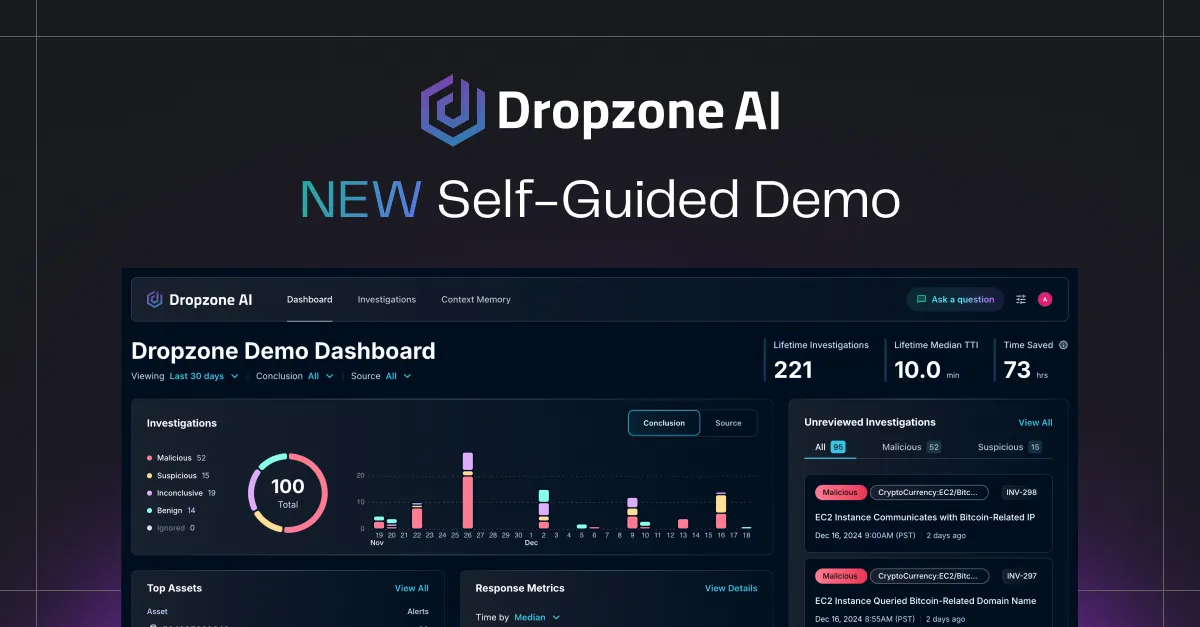
If you'd rather see the investigation step before you plan around it, the self-guided demo lets you watch the AI SOC Analyst work real alerts and return findings with the evidence attached, and there's nothing to set up.
Key takeaways
- Alert fatigue is a capacity gap, the point where alert volume exceeds what the team can investigate, and it builds up at investigation, not detection.
- The usual fixes work on the count. Tuning, thresholds, playbooks and hiring each help and then stall, because none of them changes what happens to an alert once it fires.
- The fix is investigating every alert, delivering findings instead of raw alerts, letting corrections stick and setting the limits, each with a named customer result behind it.
- Measure it by severity band with the uninvestigated share, MTTA trend read against the backlog, and escalation quality.





.png)