

AI SOC agents like Dropzone reduce alert fatigue for healthcare security teams by handling Tier-1 investigations with the same reasoning you'd expect from a trained human, but with the speed and consistency needed to cover staffing, skill, and coverage gaps. Healthcare providers face mounting cyberattacks, ransomware attempts costing an average of $5.08 million per attack (IBM 2025), and identity-driven threats, all of which can disrupt clinical operations and patient care. With healthcare breaches costing an average of $7.42 million, the most expensive of any industry (IBM 2025), most IT and security teams are still understaffed, juggling clinical support, compliance work, and day-to-day operations alongside alerts from EHR systems, IoMT devices, cloud platforms, and hybrid on-prem environments. This article explains why healthcare organizations are increasingly turning to AI-driven investigation automation to keep up with rising demands.
Why Are Healthcare Security Teams Stretched So Thin?
Healthcare security teams are stretched thin because they can't compete with tech and finance salaries, while the people they do hire juggle clinical support, compliance, and operations alongside security. Alert volume from EHR systems, IoMT devices, cloud platforms, and clinical desktops compounds the problem, creating a workload that overwhelms teams already spread across too many responsibilities.

The Hiring and Retention Gap
Healthcare providers can't compete with the salaries offered in tech or finance, making hiring tough and retention even tougher. Across the industry, 62% of SOC professionals say their organization isn't doing enough to retain top talent (SANS 2025).
62% of healthcare organizations report difficulty hiring and retaining qualified cybersecurity staff, according to a 2025 survey of 3,400 healthcare cybersecurity professionals by Black Book Market Research.
The people who do join usually wear several hats: helping clinicians with access issues, supporting uptime work, handling patching cycles, and managing compliance tasks. With so much happening at once, it's hard for anyone to sit down and run a deep investigation the way they'd like to.
Because of this, teams are constantly pulled in different directions. They want to investigate alerts thoroughly, but the day-to-day demands of a hospital or clinic rarely leave enough time or focus.
That gap becomes even larger when specialized investigative skills are needed, especially for identity misuse, cloud activity, or device behavior. Dropzone steps in to take on that work automatically, applying full reasoning and context so the team doesn't have to stretch themselves even thinner.
For many providers, this support makes a real difference. Even if headcount is low or experience varies across shifts, they still get consistent, well-documented investigations that they can trust and use for response, reporting, and audits.
Alert Volume Across Clinical Environments
Healthcare environments generate alerts from everywhere:
- EHR systems and clinical desktops
- Telehealth platforms
- Cloud identity tools
- VPN access
- IoMT devices
All of this funnels into SIEM or XDR platforms, and the volume can be overwhelming. Teams already pressed for time now have to figure out what's noise, what's normal clinical behavior, and what might be a real issue.
When you're understaffed, correlating events across so many systems is exhausting. Alerts pile up, people fall behind, and it becomes easier to miss something important simply because the workload never slows down. Many teams share that this alert fatigue is one of the most significant sources of stress in their day.
Dropzone helps cut through that noise by pulling together identity data, endpoint activity, cloud signals, network behavior, and any routed device alerts into a single, clear investigation. Instead of jumping between tools or guessing what might be related, analysts get a full picture laid out for them, making it easier to respond quickly and confidently.
How Can Healthcare SOCs Improve Investigations Without More Staff?
AI-driven investigation automation gives healthcare SOCs consistent, defensible analysis without requiring additional headcount. Every alert goes through a structured reasoning process that produces the same quality of investigation regardless of who's on shift, with documentation that aligns with HIPAA and HITECH requirements.

Consistent, Defensible Alert Analysis
AI-driven investigation delivers consistent, defensible alert analysis by running every investigation through a clear reasoning path: gathering the proper logs, checking assumptions, reconstructing the sequence of events, and producing a detailed explanation of what happened and why it matters. The output aligns with what HIPAA and HITECH require for incident documentation, so teams can rely on it without having to fill in gaps or recreate the investigation manually.
Healthcare alerts often require careful investigation, and teams tell us how much time they spend trying to answer what should be simple questions: Was that unusual login just a clinician moving between floors, or was someone actually accessing an account they shouldn't? Did a medical device behave oddly because of harmless system noise, or was there something more serious behind it? These are subtle distinctions, and the pressure to get them right is high. Organizations take an average of 241 days to identify and contain a breach (IBM 2025). Consistent, automated investigation helps close that window significantly.
Freeing Security Teams for Patient-Critical Work
AI investigation automation takes repetitive triage off the team's plate, speeding up MTTR and removing the constant churn of low-value alert review so analysts can focus on work that directly supports patient care:
- Keeping the EHR stable
- Improving the security of clinical networks
- Helping clinicians with access needs
- Preparing for Joint Commission or OCR reviews
Most healthcare security teams currently spend too much of their day on low-signal alerts that rarely turn into real issues but still demand attention. AI and automation shorten breach lifecycle by 80 days (IBM 2025), giving analysts the breathing room to focus on the tasks that truly impact care delivery and organizational readiness.
Because Dropzone’s AI SOC analyst fits into existing SIEM, SOAR, and healthcare systems, teams don't have to change tools or redesign workflows. It slides into the environment they already have and supports the work they're already doing, just with far less manual effort.
How Does AI Security Keep Pace With 24/7 Clinical Operations?
AI investigation agents match daytime investigative quality during nights, weekends, and holidays, closing the coverage gap that leaves most healthcare SOCs exposed during off-hours. Automated verification before analyst escalation reduces on-call burnout, so teams start each morning with clear findings instead of a backlog of unreviewed alerts.

Full Security Coverage Overnight
AI investigation agents provide the same level of investigative depth at 2 a.m. that teams expect during the day, with every alert reviewed with full context and reasoning regardless of time, day, or staffing level.
Hospitals don't slow down at night; emergency departments, ICUs, and surgical floors keep moving, and the systems supporting them generate alerts around the clock. Identity anomalies, remote-access attempts, unusual EHR access patterns, and even medical device alerts often surface overnight, when security staffing is at its lowest. Teams feel the pressure of knowing that a missed alert in the middle of the night can have a real impact on clinical operations.
With Dropzone handling overnight investigations, analysts come in each morning to clear, well-structured findings instead of a pile of alerts or rushed after-hours triage. It gives teams a better starting point for the day and lowers the chance that something important slipped through during off-hours.
Reducing On-Call Burnout
AI reduces on-call burnout by automatically verifying suspicious activity before involving an analyst. If a login or access pattern looks unusual, Dropzone can reach out to the user directly and confirm the activity, only escalating when genuine human review is needed. This leads to fewer overnight disruptions and a healthier on-call rotation.
On-call rotations currently take a real toll on healthcare security teams. Many analysts describe how often they're woken up by activity that turns out to be normal clinician behavior: someone logging in from a different floor, working late, or briefly accessing a system while on call. Those interruptions add up and contribute to one of the biggest burnout challenges in the sector.
This support strengthens overall resilience. With fewer missed alerts, clearer overnight documentation, and faster handling of identity or access concerns, healthcare organizations are better positioned to meet HIPAA incident-response expectations, defend against ransomware, and maintain continuity across clinical services. Teams get steadier coverage without needing to grow their overnight staff, and leadership gains confidence that the environment is protected at all hours.
Key Takeaways
- Healthcare security teams are stretched across clinical support, compliance, and operations with limited bandwidth for deep alert investigation
- AI-driven investigation automation delivers consistent, defensible alert analysis that aligns with HIPAA and HITECH documentation requirements
- 24/7 investigative coverage closes the overnight and weekend gap without expanding headcount or increasing on-call burden
- Dropzone fits into existing SIEM, SOAR, and healthcare systems without requiring workflow changes or tool replacement
Conclusion
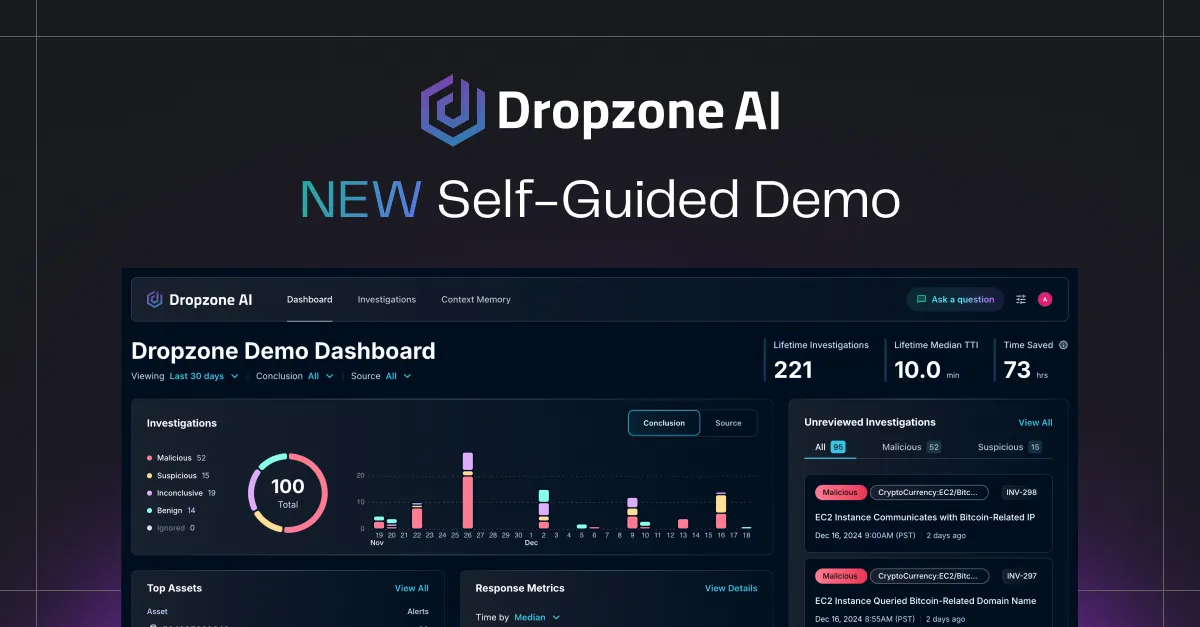
Healthcare providers work in one of the most demanding environments in cybersecurity, where limited resources collide with high-stakes clinical operations. Dropzone helps close staffing and expertise gaps by delivering investigations that mirror a trained analyst's reasoning while operating at machine speed. Faster MTTR, fewer noisy alerts, consistent documentation, and true 24/7 coverage give teams a stronger security posture without adding more pressure to already stretched staff. Organizations using AI extensively in security save $1.9 million per breach on average (IBM 2025). For hospitals and health systems that need more capability than their current staffing can provide, Dropzone offers a direct, achievable path to resilience. See it for yourself in our self-guided demo, a live environment where you can explore Dropzone investigations.








.png)