

Introduction
After years of budget and buildout, a security stack can look airtight on paper. Then nearly half the alerts it generates go uninvestigated or intelligence isn’t operationalized quickly enough, and leadership starts asking why all that spending still isn't buying safety. The bottleneck is capacity, the human hours to actually run what you already own. This guide shows how an Agentic SOC closes that gap and how to package the fix as a defensible 2027 budget request.
Why Don't Your Security Tools Deliver Their ROI?

Your Tools Don't Operate Themselves
A security tool only returns value when someone has the hours to operate it, and most teams ran out of those hours a long time ago. The spend is on the books, but the protection it was supposed to buy never got operationalized. Instead, it remained shelfware.
Your alert queue is the clearest example: research commissioned by Microsoft and conducted by Omdia found that 42% of security alerts go uninvestigated, as detailed in the resulting State of the SOC report. The detections fired correctly. What ran out was the capacity to investigate what they surfaced.
That uninvestigated chunk is a detection you already paid for, a firing signal nobody has the hours to chase down. Shelfware isn't only the tools nobody opens. The bigger waste is the unused capability sitting inside the tools you run every day, because the people who'd act on it are already underwater.
Can You Consolidate or Hire Your Way Out?
The two reflexive fixes are to consolidate or hire more. In Gartner's 2022 survey, 75% of organizations were pursuing security vendor consolidation, up from 29% in 2020, as reported by CSO Online. The mandate is to squeeze value out of the stack, not to add to it. But consolidating vendors can be disruptive (think rip-and-replace) and lead to compromises, especially when there is so much innovation happening outside of large platforms.
Hiring your way out isn't on the table either. ISC2 found that 33% of organizations say they lack the resources to adequately staff their security teams, and 29% cannot afford the skills they need, with 88% reporting at least one significant consequence from the shortage.
So you're squeezed from both sides; you're told to consolidate spend while the hiring market won't deliver the analysts who would let your existing stack finally pay off. Capacity has to come from somewhere other than more boxes or more bodies, and that's the exact opening an Agentic SOC fills.
How Does an Agentic SOC Increase ROI on Security Tools?

A Team of Agents, Not a Single Bot
The Agentic SOC is a team of AI agents that collaborate across detection and response, each replicating an expert human's techniques in its role, rather than relying on a single analyst bot. You've got the AI SOC Analyst running autonomous Tier-1 investigations, the AI Threat Hunter running hypothesis-driven hunts, and the AI TI Analyst operationalizing threat intelligence around the clock.
These agents share a core reasoning model, tool skills, threat models, and company context, and they act with self-agency inside the boundaries you set, so there's no human bottleneck wedged between steps.
You stay on the loop, getting notified at key points, directing the strategy, and setting scope, authorization, and business context. Day-to-day, your human analysts stop clearing a Tier-1 queue by hand and start directing a team to execute investigations and hunts at machine scale, freeing them to focus on the higher-value work they were hired to do.
This is augmentation, and Gartner backs that framing outright. A fully autonomous SOC will never be feasible, and security leaders should aim for AI to augment analysts rather than replace them, per its Predict 2025 research. A 2027 line item for an Agentic SOC that directs human-supervised agents stays right on that curve rather than betting ahead of it.
How Do Agents Make Your Tools Pay Off?
The agents raise the return on your existing stack in two ways:
- First, the agents investigate the alerts your tools generate across SIEM, EDR, identity, cloud, and email, so detections that used to be routed to an unread queue now receive a full investigation. Every alert gets eyes on glass and hands on keyboard without you adding either one. ECS, one of North America's top-ranked MSSPs, runs 30,000 alerts a month through Dropzone AI on exactly this model.
- Second, the agents use those same tools as data sources during investigations and threat hunts, putting the telemetry your stack already to good use. This is how the alerts that used to die in the queue, and the logs no one had the hours to query, finally get worked on, and it takes the whole team to make it real.
- Third, the agents can generate detections that can improve the quality of your security fabric based on findings from threat hunts or threat intelligence analysis.
The AI Threat Hunter queries those same logs to run hypothesis-driven hunts across ground your alerts never flagged, while the AI SOC Analyst reaches into identity, cloud, and endpoint sources mid-investigation across Dropzone's 90+ integrations.
The labor math goes straight into the budget conversation:
- The AI Threat Hunter compresses 10 to 20 hours of hunting into about an hour.
- Investigations average about 7 minutes using the OSCAR methodology with no log shipping required.
- Zapier reclaimed 1 to 2 analyst hours a day after cutting manual investigation time by 85% on this model.
None of it competes with your SIEM or SOAR, which keep detecting, storing, and automating response playbooks, while the agents add investigative reasoning they don't have and read data the SIEM doesn't hold, such as email, calendar, and identity logs.
How Do You Turn Security Tool ROI Into a 2027 Budget Case?

Translating Speed of Containment Into Dollars
The budget case rests on a mechanism your CFO already understands. Faster containment is risk avoidance (the entire purpose of your security program). If you’re interested in seeing what the numbers might look like for your organization, we have an ROI calculator for faster MTTR that you can see from Dropzone AI.
Organizations that use AI and automation extensively save about $1.9M per breach, with costs dropping from $5.52M to $3.62M, and shorten the breach lifecycle by roughly 80 days, according to IBM's Cost of a Data Breach Report 2025.
The average breach lasts 241 days, and breaches contained within under 200 days cost $3.61M, compared with $5.49M for slower ones, a spread that maps almost directly to investigation speed.
The Agentic SOC delivers exactly that mechanism by investigating every alert within minutes, rather than letting it age in a queue, where containment delays and costs quietly pile up.
So present the line item as a multiplier on already-approved spend, rather than as net-new tooling. Leadership signed off on the stack. This is what finally makes that signature return its value.
How Do You Frame the Cost of Inaction for the Board?
The strongest budget requests quantify the cost of standing still, and here that cost is the unrealized protection you've already paid for plus the breach exposure it leaves wide open. Tie the two numbers together for the board. (And maybe remind them that attackers are using LLMs to get more efficient and effective as well.)
Your stack covers a fraction of what it could, and the breach math shows what slow investigation costs, so doing nothing is an ongoing, measurable loss rather than a neutral hold.
The framing also answers the board's likely objection before anyone raises it. The responsible, analyst-backed view of AI is of it as a teammate that amplifies people under human oversight, which is the Agentic SOC model exactly.
And the case doesn't rely on a hiring market that can't deliver, with the return visible within the same budget cycle, which holds up under scrutiny.
Give yourself the one-line version to carry upstairs: We already bought the protection; this is the capacity to finally realize it, and here is what every quarter of waiting costs us.
Conclusion
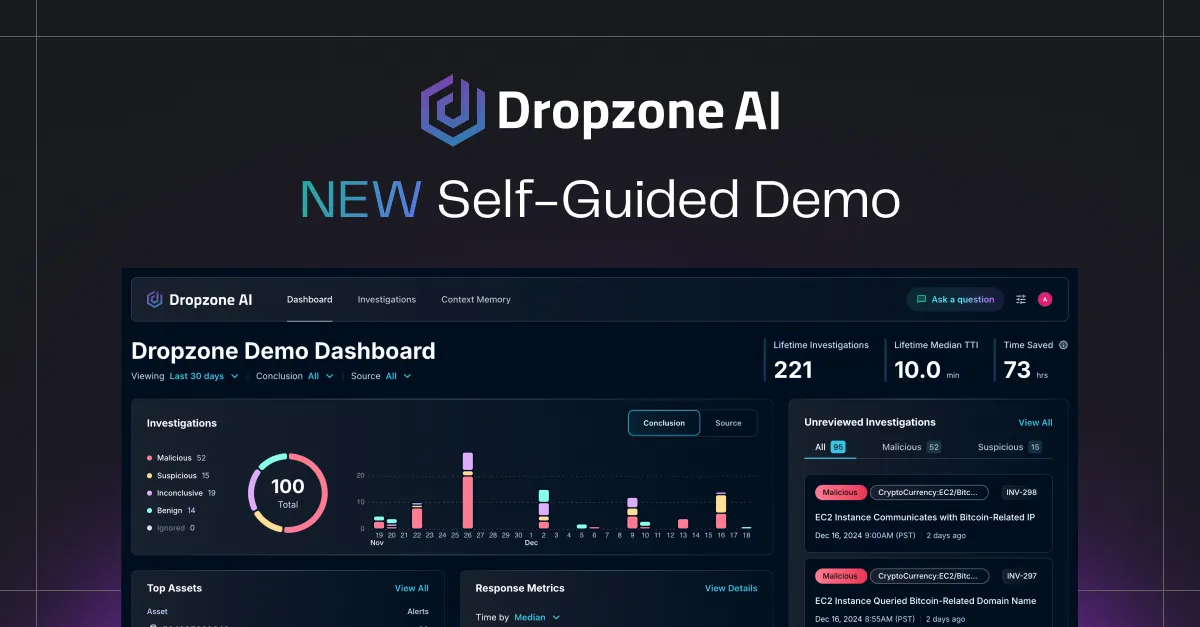
The security technology is already paid for; the piece that was always missing is the capacity to realize it, and an Agentic SOC adds exactly that, without rip-and-replace or new headcount. Framed as a multiplier on spend your leadership already approved, a 2027 budget line defends itself, and the cost of waiting is another year of alerts no one had time to investigate. See what that capacity looks like in the Dropzone self-guided demo, where you can walk through real investigations at your own pace and watch the agents work an alert end-to-end.
Key Takeaways
- Capacity, not tools. Roughly 42% of security alerts go uninvestigated, not because the tools failed but because no one has the hours to work the queue.
- Two ROI levers. The Agentic SOC investigates the alerts and analyzes the intelligence your tools generate, and uses those same tools as data sources, so the AI SOC Analyst, AI Threat Hunter, and AI TI Analyst convert underused spend into realized coverage.
- Defensible 2027 ask. When you build a case for Agentic SOC spend for your CFO, frame it as a multiplier on approved spend, backed by IBM breach math showing roughly $1.9M saved per breach with faster containment, with no rip-and-replace or new headcount.








.png)