

Organizations invest heavily in detection stacks. SIEM platforms, EDR agents, network monitoring, cloud security posture tools. Yet in 2024, 57% of all compromises were discovered by external parties, not the organization's own security team (Mandiant M-Trends 2025). Someone else found the breach first.
That gap is not a tooling failure. It is a coverage failure. Automated detection catches what it is designed to catch: known threats with known signatures. Everything else, the adversary using your own tools against you, the attacker who moves slowly enough to stay below alerting thresholds, the novel technique with no signature yet, slips through. Proactive threat hunting is the practice built to find what slips through. And it has never been more essential.
Why Does Reactive Security Fall Short?
Reactive security waits for automated systems to flag known threats. The problem is that modern attackers have learned to avoid triggering those systems entirely.
Living-off-the-land (LOTL) attacks are the clearest example. Instead of deploying custom malware that endpoint detection can flag, adversaries use tools already present in the environment: PowerShell, WMI, scheduled tasks, Remote Desktop Protocol. The tools are legitimate. The behavior is not. But signature-based threat detection evaluates artifacts, not behavior, so these attacks pass through undetected.
This is not a niche technique. According to the SANS 2025 Threat Hunting Survey, 76% of organizations have encountered LOTL techniques from nation-state actors. Nearly half of ransomware attacks in 2024 used LOTL methods, up from 42% the prior year. Attackers are using this approach more because it works.
The speed asymmetry makes it worse. Attackers achieve mass exploitation of critical vulnerabilities within 5 days of disclosure. Organizations take a median of 38 days to remediate (Verizon 2025 DBIR). By the time the patch is deployed, the attacker may already be inside, operating with legitimate credentials and legitimate tools the detection stack was never designed to question.
Automated detection has a defined job: catch known threats. Proactive cyber security threat hunting has a different one: find the threats that automation misses.
What Does Attacker Dwell Time Actually Cost?
Dwell time in cybersecurity is the number of days an adversary remains undetected inside a compromised environment. It is the window during which an attacker can move laterally, escalate privileges, exfiltrate data, and establish persistence, all before anyone knows they are there.
In 2024, global median dwell time rose to 11 days. That is the first increase since Mandiant began tracking the metric in 2010 (M-Trends 2025). The number is shorter than historical averages, when dwell time was measured in months, but the trend line has reversed. For ransomware specifically, the window is even tighter. Many operators deploy payloads within hours of gaining initial access.
Here is what makes dwell time so costly: every additional day of undetected presence multiplies the damage.
- Day 1-3: Initial access, credential harvesting, internal reconnaissance
- Day 4-7: Lateral movement, privilege escalation, persistence mechanisms
- Day 7+: Data staging, exfiltration, or ransomware deployment
The average breach lifecycle from identification through containment stretches to 241 days, and the average breach costs $4.44 million globally (IBM Cost of a Data Breach 2025). Detection and escalation remain the single largest cost component for the fourth year running. The math is straightforward: find threats earlier, pay less to contain them.
What Makes Proactive Threat Hunting Different From Detection?
Proactive threat hunting is the analyst-driven practice of searching for threats that have evaded automated detection. Unlike reactive security, which waits for an alert, cyber threat hunting assumes the environment may already be compromised and actively searches for evidence of adversary presence.
The distinction comes down to who initiates the investigation.
- Reactive detection: The tool fires an alert. An analyst investigates.
- Proactive hunting: The analyst forms a hypothesis about adversary behavior and searches for evidence, whether or not any alert exists.
That difference matters because of the three categories of threats that hunting catches and automated detection typically misses:
1. Living-off-the-land techniques. Adversaries using legitimate tools like PowerShell and RDP that do not match malware signatures. These are increasingly common and do not generate the artifacts that trigger automated alerts.
2. Slow-and-low persistence. Attackers who establish footholds quietly and move laterally over weeks or months, staying below the thresholds designed to catch obvious anomalies.
3. Novel attack chains. New combinations of TTPs (Tactics, Techniques, and Procedures) with no existing signatures because no one has observed them before.
MITRE ATT&CK provides the systematic framework for mapping these adversary behaviors. Hunters use ATT&CK technique profiles as the basis for threat hunting techniques: building hypotheses about what specific adversary activity might look like in their environment, then searching for evidence.
A real-world example illustrates the point. In July 2025, CISA and the U.S. Coast Guard conducted a proactive threat hunt at a critical infrastructure organization. The team mapped their findings across nine MITRE ATT&CK tactic categories. They found no active attacker. But they identified six significant security gaps that would have been invisible without a deliberate hunt. That is what proactive threat detection delivers: actionable findings whether or not a live threat is confirmed.
For the methodology behind building and testing hunting hypotheses, see hypothesis-driven threat hunting.
Why Can't Most Teams Hunt Proactively Today?
The primary barrier to proactive threat hunting is not methodology or tooling. It is staffing. 61% of organizations cite staffing shortages as the top obstacle to running effective hunting programs (SANS 2025 Threat Hunting Survey).
Hunting requires a specific skill set: the ability to form hypotheses, interrogate data across multiple sources, and distinguish benign noise from genuine adversary activity. A single manual hunt takes 10 or more hours of focused analyst time.
Most SOC teams are already consumed by reactive alert triage. Asking them to carve out time for proactive hunts is asking them to do more of the work that matters most while already behind on the work that is most urgent. That tension does not resolve with better prioritization. It resolves with more capacity.
The result is a paradox: the most dangerous threats, the ones that evade automated detection, go undetected the longest because no one has the bandwidth to look for them.
How Does AI-Augmented Hunting Close the Gap?
AI-augmented threat hunting automates the search and analysis phases of the hunting cycle while analysts retain control over hypothesis generation, strategic direction, and decision-making. This model makes proactive threat hunting operationally viable for teams that cannot staff dedicated full-time threat hunters.
The division of labor works like this:
- Analysts generate hypotheses based on threat intelligence, environmental risk, and adversary profiles
- AI automates the search across SIEM, EDR, and cloud data sources at machine speed
- Analysts review findings and decide on response
What changes is the throughput. Instead of one analyst querying one data source for one hypothesis over a full day, AI-augmented systems search across all connected sources simultaneously, run behavioral pattern matching, test multiple hypotheses in parallel, and surface findings for review. The analyst who previously ran one or two manual hunts per quarter can now oversee continuous hunting operations.
The IBM data confirms the impact: organizations using AI and automation reduce the breach lifecycle by 80 days on average and save $1.9 million in breach costs. The savings come directly from faster detection, which is exactly what proactive hunting delivers.
AI does not replace the hunter's judgment. It removes the capacity bottleneck that prevents most teams from hunting at all. For a wider view of the category, see our buyer's guide to threat hunting tools and platforms.
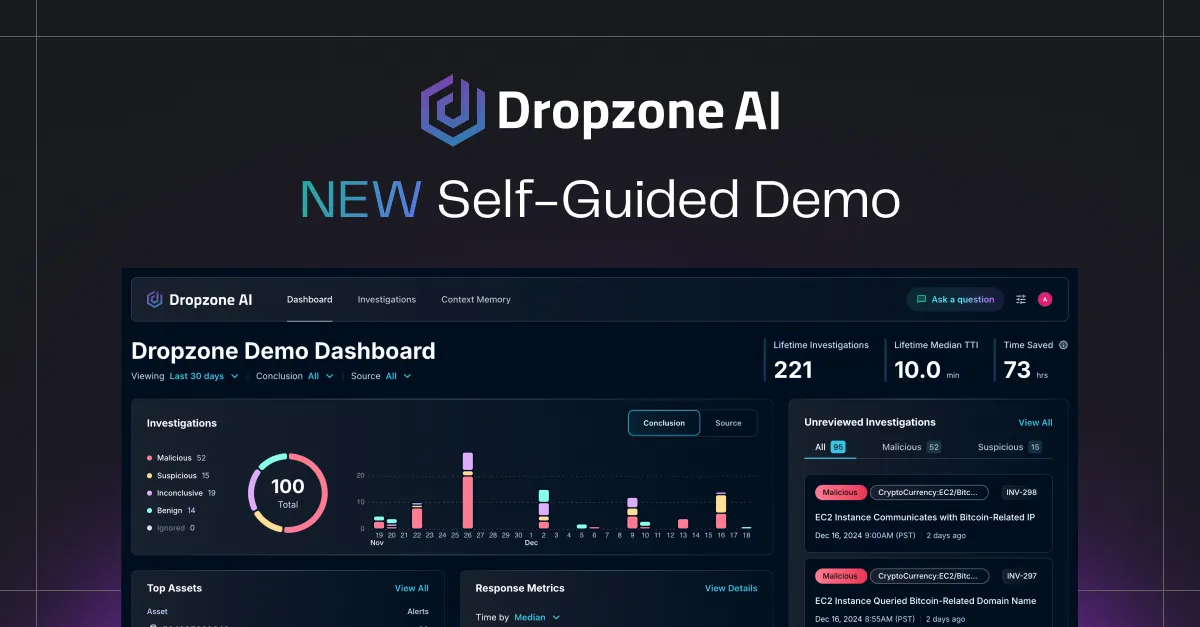
Dropzone AI's AI Threat Hunter is built for this model. Analysts direct the hunt. The AI Threat Hunter searches federated across all connected data sources, surfaces behavioral matches, and presents findings for analyst review.
Key Takeaways
- Most compromises are found by outsiders, not internal teams. Automated detection alone leaves critical gaps.
- Attacker dwell time is trending the wrong direction. The window between compromise and detection is where damage compounds.
- Living-off-the-land techniques are the primary blind spot. Attackers using legitimate tools bypass signature-based detection by design.
- Proactive threat hunting finds what automation misses: LOTL techniques, slow-and-low persistence, and novel attack chains.
- Staffing is the biggest barrier. Most teams know they should hunt but cannot free analysts from reactive alert triage.
- AI-augmented hunting removes the capacity bottleneck. Analysts direct strategy. AI handles the search. Hunting becomes continuous, not quarterly.
Conclusion
The structural asymmetry favors attackers. They exploit vulnerabilities in days while patches take weeks. They use legitimate tools that bypass signature-based detection. And organizations routinely learn about their own compromises from someone else.
Proactive threat hunting is the practice that closes these gaps. The barrier to running it at scale is not methodology. It is analyst capacity. AI-augmented hunting removes that bottleneck by automating the search while analysts direct the strategy.
The organizations that hunt proactively find threats faster. The organizations that do not are the ones reading about their breach in someone else's report.
Dropzone AI's AI Threat Hunter automates the search and analysis phases of the hunting cycle so analysts can focus on hypothesis generation and strategic response. Request early access.













.png)