

Threat hunting tools fall into three layers. Data collection platforms, your security information and event management (SIEM) system and endpoint detection and response (EDR) tooling, capture the telemetry. Analysis tools add context. AI-augmented platforms run the threat hunt itself, hypothesis to evidence. Most SOCs own the first layer, have pieces of the second, and are evaluating the third. This guide compares all three and gives you a checklist for the third.
Most SOC teams are tool-rich and insight-poor. They've got a SIEM, an EDR platform, maybe a security orchestration, automation and response (SOAR) platform running pre-written steps, and a growing stack of point solutions.
Yet only 38% of SOCs describe their threat hunting as partially automated with mainly vendor-provided tools, and 23% describe it as fully manual (SANS SOC Survey 2026). The tools exist. The hunting still stalls.
What's missing is rarely data. Most SOCs hold more telemetry than they can work. What's missing is time, the skills to use what's already there, and anything that carries a hypothesis from one tool to the next.
SANS puts a number on that gap. 79% of respondents use AI or machine learning tools, but only 36% have built them into a defined SOC workflow (SANS SOC Survey 2026). Buying the tool is no longer the hard part. Making it part of how the SOC works is.
What does a complete threat hunting toolkit look like?
Threat hunting tools are the technologies analysts use to go looking for threats that automated detection missed. Effective hunting doesn't rely on a single product. It takes three layers working together, and most buying decisions come down to which layer you're short of.
Every layer below the third produces work for analysts. Only the third takes work off their plate, which is why buyers routinely overspend on data collection and underspend on the analysis that makes hunting productive.
SIEMs provide the foundation, not the answer
SIEM platforms like Splunk, IBM QRadar and Elastic Security are central log repositories. They aggregate data from across the environment and give analysts the historical search they need to test a hypothesis.
The strength of a SIEM is breadth. It puts many data sources in one place. The limitation is that SIEMs are query-driven. You find what you know to ask for. Novel threats that fall outside predefined correlation rules or known indicators of compromise (IOCs) can sit in SIEM data for months without surfacing.
Cost matters too. SIEM licensing at scale can eat a serious share of the security budget, and teams frequently end up ingesting more data than they can meaningfully analyze.
EDR and XDR deliver endpoint depth
EDR platforms like CrowdStrike Falcon, SentinelOne and Microsoft Defender for Endpoint give deep behavioral visibility into what's happening on individual machines. Extended detection and response (XDR) widens that to include network, email and cloud telemetry.
These tools are critical for hunting. 86% of SOCs say endpoint security alerts trigger a response, while evidence uncovered by proactive hunting triggers one for 63% (SANS SOC Survey 2026). Most SOCs still find threats because something flagged them.
They're strong at capturing process execution chains, lateral movement indicators, and behavioral anomalies that signature-based tools miss.
The limitation is silos. EDR telemetry is rich but narrow. Without integration into a wider hunting workflow, analysts end up pivoting between tools, correlating evidence by hand, and losing the shift to context-switching instead of investigation.
Where do open-source threat hunting tools fit in?
Between the enterprise platforms and the AI-augmented category sits a practical layer of analysis tools, many of them open source, that fill specific visibility gaps. They're not a lesser version of the commercial options. For the jobs below they're what practitioners actually reach for.
Network and packet analysis fill visibility gaps
Zeek (formerly Bro) does behavioral network analysis, turning raw traffic into structured logs that suit hunting lateral movement and command-and-control activity. Wireshark does deep packet inspection when you need to examine specific connections in detail. Suricata and Snort handle real-time network intrusion detection using signature and protocol-based rules.
These tools are best deployed together. Zeek captures the behavioral patterns, Suricata catches the known signatures, and Wireshark goes deep once you've found something worth pulling apart.
On the endpoint side, OSquery lets analysts query fleet state with SQL, and Velociraptor does live forensics and hunting across endpoints. Sigma is worth knowing separately. It's a vendor-neutral format for detection logic, so a rule written once converts to whatever SIEM query language you're running.
In several of these jobs the open-source option is simply the better tool. Wireshark is still the default for packet-level forensics, Zeek's logs are the format much commercial tooling normalizes toward, and Sigma is how detection logic stays portable when you change SIEM.
Threat intelligence platforms add context
Threat intelligence platforms (TIPs) correlate indicators of compromise with known adversary tactics, techniques and procedures (TTPs) mapped to frameworks like MITRE ATT&CK. They turn isolated IOCs into hunting hypotheses that threat hunters can test.
Open-source options like MISP and OpenCTI are solid foundations for teams with the depth to deploy and maintain them. Commercial feeds from providers like Recorded Future and Mandiant add breadth and timeliness at a higher price.
What open-source tooling asks for in return is people. These are components, not a program, and someone has to deploy them, maintain them, and carry a hypothesis from one to the next.
What makes AI-augmented threat hunting tools a distinct category?
The three-layer framework has worked for years, but it puts the whole analytical burden on analysts, who write the SIEM queries, correlate the EDR telemetry, and build hypotheses they then chase by hand across several tools. That doesn't scale.
AI-augmented hunting platforms are AI agents that run the hunting process itself. Instead of handing analysts more data to work through, the agent forms a hypothesis, runs federated queries across SIEM, EDR and cloud telemetry, analyzes what comes back, and compiles the evidence. No predefined playbook decides its path.
Dropzone AI's AI Threat Hunter is one example. It runs hypothesis-driven hunts across SIEM, EDR and cloud sources, and it ships with 270+ hunt packs.
The time compression is the result buyers should test. Hunts that consumed up to 40 hours of manual analyst work compressed to roughly one hour, the figure Andrew Marsh, Director of Information Security at Indiana Farm Bureau Insurance, reported in the agent's March 2026 launch announcement. 88% of respondents say their organization experienced at least one significant cybersecurity consequence because of a skills deficiency, and 48% report feeling exhausted from trying to stay current with threats and emerging technologies (ISC2 Cybersecurity Workforce Study 2025).
AI-augmented platforms take the investigative workload at machine scale so analysts can direct where the hunting goes.
What separates these platforms from traditional automation like SOAR playbooks is reasoning. SOAR follows predefined decision trees and keeps that job. AI-augmented platforms interpret context, adapt the investigation based on what they find, and handle scenarios no playbook anticipated.
The best of them show their reasoning openly, producing evidence chains an analyst can review, validate and learn from.
How should I evaluate threat hunting tools and platforms?
Not all AI-augmented platforms are equal, and the category is young enough that the demos look more alike than the products are. Take this table into the vendor call.
Decide how you'll measure a pilot before you run one. Our guide to threat hunting metrics covers which KPIs show whether a hunting program is working, so the evaluation produces evidence rather than impressions.
Key takeaways
- Effective hunting takes a layered toolkit. SIEM and EDR provide the data foundation. Open-source analysis tools and TIPs fill specific visibility gaps. AI-augmented platforms run the hunting process itself.
- The third layer is the one that removes work. Every layer below it produces more for analysts to do.
- Integration is now the hard part, not adoption. 79% of respondents use AI or ML tools; only 36% have built them into a defined workflow (SANS SOC Survey 2026).
- Evaluate on all eight: automation depth, reasoning, integration, transparency, team impact, oversight limits, durability and cost. Demos look alike. These questions separate them.
- Analysts stay in charge of the hunting. What changes is how often they get to do it.
See AI-augmented threat hunting in action
Most threat hunting tools give you data and leave the analysis to your team. Dropzone AI builds AI agents that take on that analysis. Under the agentic SOC model, AI agents handle the repetitive investigative work while analysts direct strategy and own every verdict.
The AI SOC Analyst investigates every alert end to end and delivers verdicts backed by evidence and a guided remediation plan, and you set where the agents stop.
The AI Threat Hunter works the same way for hunting, running the hunt packs or hypothesis-driven hunts your team selects and delivering decision-ready findings on what it checked and what it found.
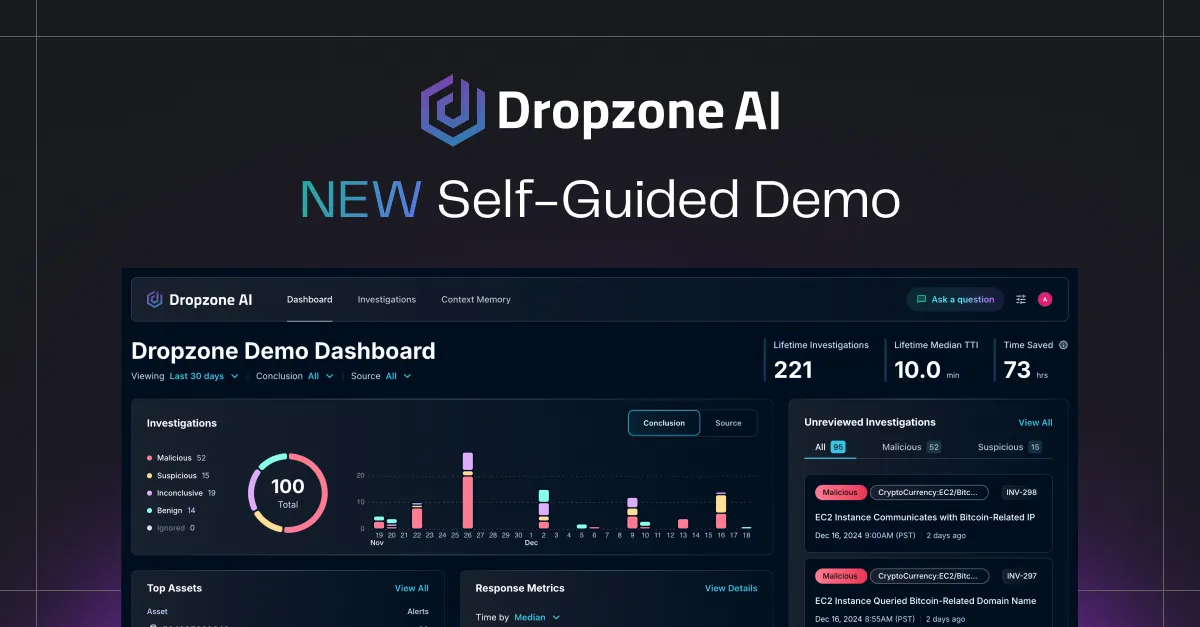
See the AI SOC Analyst in the self-guided demo, or read the SANS SOC Survey report for how practitioners describe the state of security operations in their own words.
.jpg)









.png)