
Introduction
SOC teams are feeling the pressure as alert queues grow faster than anyone can clear them, staffing is tight, and keeping investigations consistent around the clock is harder than most teams want to admit. Even straightforward alerts demand careful context gathering and validation, which drains time and energy that teams don't have to spare. Teams tell us they're not looking for another summary or dashboard; they want investigations that reflect real human judgment so they can move faster and trust every decision. In this article, we dig into that gap and show how organizations are tackling it today through real case studies focused on reducing MTTR, improving SOC efficiency, and delivering reliable 24/7 coverage.
MTTR Reduction: Indiana Farm Bureau Insurance
What Was Slowing Down MTTR at Indiana Farm Bureau?
Indiana Farm Bureau Insurance's SOC was spending disproportionate time gathering context for basic investigative decisions.
For every alert, analysts had to:
- Pull logs from multiple systems
- Verify user identities across directories
- Check endpoint activity and behavior
- Manually rebuild event timelines
- Cross-reference context before making decisions
A single investigation could drag on far longer than it should, especially when several alerts arrived at once.
Their SIEMs' built-in "AI features" didn't meaningfully improve that workflow. Analysts still had to redo the work themselves to be confident in any outcome.
How Did AI Investigation Reduce MTTR for IFBI?
After bringing in Dropzone AI, the team immediately noticed that investigations came back with the level of reasoning they expected from a senior analyst; each report spelled out what happened, why it mattered, and which evidence supported the conclusion. Analysts didn't have to go hunting for missing context; the full analysis was already laid out.
The measurable impact was significant. IFBI saw MTTR move 5× faster (as measured by comparing before-and-after purple team tests) and manual investigation time dropped by about 75%. During purple-team scenarios, Dropzone clearly distinguished benign testing activity from behavior that actually required escalation. Analysts gained both speed and accuracy, instead of trading one for the other.
Because Dropzone fit directly into their existing SIEM and SOAR workflows, the team didn't have to reconfigure tooling or change how they operated. The result was a meaningful reduction in MTTR and a clear boost in analyst confidence, reinforcing that investigations could be both fast and trustworthy.
Read the Indiana Farm Bureau Insurance case study.
IFBI Results
- MTTR speed: 5× faster
- Manual investigation time: 75% reduction
- Purple-team clarity: Immediate distinction between testing vs. real threats
SOC Efficiency: Zapier & Mysten Labs
What Bottlenecks Do Lean SOC Teams Face?
Zapier and Mysten Labs were both running lean SOC operations while supporting environments that generate a high volume of identity-driven and multi-cloud activity.
Their analysts were stuck in a cycle where every alert demanded manual steps:
- Pull identity records from multiple sources
- Check endpoint telemetry and logs
- Validate cloud events and access patterns
- Confirm activity aligned with expected user behavior
A single alert commonly took 10-15 minutes to investigate, which multiplied quickly into triage debt that never cleared. Neither team had a dedicated SOC, so repetitive alerts ate into limited cycles of their security engineer staff who also had other projects to complete. Work that should have been strategic tuning, detection, coverage improvement, and exposure reduction kept getting pushed aside.
Both teams knew the volume itself wasn't the only problem; the real issue was that each alert required too much human reasoning just to determine whether it was actionable.
How Did Zapier and Mysten Labs Improve SOC Efficiency?
With Dropzone AI added to their pipelines, the investigative load changed immediately. The system pulled context across endpoint telemetry, cloud logs, identity providers, network events, email systems, and insider-threat sources, then applied reasoning that mirrored an experienced analyst, validating each step.
Instead of handing analysts raw data, Dropzone returned a complete, evidence-driven assessment of what happened, who was involved, and whether the alert required attention.
For Zapier, this translated into an approximately 85% reduction in manual investigation time, giving each analyst 1-2 hours back per day previously spent on repetitive triage. Mysten Labs saw an even sharper shift: alerts requiring human investigation dropped by approximately 99%, falling from thousands per month to under 20.
Their investigation cycle times improved by more than 90%, allowing the team to reallocate nearly all of their time to enhancing posture rather than sifting through noise.
Deployment was rapid, both teams were fully onboarded in under one day, and because Dropzone can be tuned to match the nuances of each environment, both SOCs trained it to understand what should be surfaced versus filtered out.
This resulted in analysts no longer being trapped in alert churn, fatigue dropping, and the SOC's signal-to-noise ratio tightening across every alert category. Both teams finally had the bandwidth to operate proactively rather than constantly catch up.
Read the Mysten Labs case study.
Efficiency Gains
Zapier:
- Manual investigation time: ~85% reduction
- Analyst time recovered: 1-2 hours per day
- Deployment time: Under 1 day
Mysten Labs:
- Alerts requiring review: 99% reduction (thousands → under 20/month)
- Investigation cycle times: 90%+ improvement
- Deployment time: Under 1 day
24/7 SOC Coverage: Pipe & Lemonade
Why Is 24/7 SOC Coverage Difficult to Maintain?
Pipe and Lemonade were running into the same problem many modern teams face: maintaining true 24/7 coverage is tough without a large, highly skilled staff. Hiring analysts who can reliably cover nights, weekends, and global time zones is expensive, slow, and often unrealistic.
Meanwhile, both companies operate with geo-distributed workforces, which naturally trigger after-hours alerts to unusual logins, location-based anomalies, or identity events that require validation.
These alerts routinely escalated to on-call staff, disrupting sleep and leading to inconsistent responses across analysts. Overnight triage was not only draining; it opened the door to missed signals and uneven investigation quality.
How Did Pipe and Lemonade Achieve Always-On Coverage?
Once Dropzone AI was brought into their workflows, both teams gained continuous, full-depth investigations without relying on overnight coverage from human analysts.
Every alert, even those generated at 2 a.m., received the same level of reasoning, context gathering, and step-by-step validation they would expect from a trained SOC analyst.
When login behavior or user activity needed clarification, Dropzone automatically contacted employees to verify the event, allowing the SOC to confirm legitimacy without waking on-call staff.
Pipe saw over 75% fewer alerts requiring human review, approximately 90% faster handling of escalated investigations, and reclaimed around 25% of engineering time previously spent responding to after-hours noise.
Lemonade used Dropzone to sustain fully continuous coverage even as alert volume increased with company growth, avoiding the need to hire additional analysts or expand on-call rotations.
Both teams ended up with predictable, reliable investigations across every time zone, nights, weekends, and holidays with the same depth and clarity they expect during business hours. The result was a level of consistency and coverage that would previously have required significant, costly staffing.
24/7 Coverage Results
Pipe:
- Alerts needing human review: 75%+ reduction
- Escalated investigation speed: ~90% faster
- Engineering time reclaimed: ~25%
Lemonade:
- Continuous coverage maintained during growth
- Zero additional on-call staffing required
Conclusion
Enterprises turn to AI SOC technology because they need faster MTTR, cleaner signal-to-noise ratios, and dependable coverage that doesn't depend on hiring an around-the-clock team.
The experiences of Indiana Farm Bureau Insurance, Zapier, Mysten Labs, Pipe, and Lemonade all point to the same outcome: when investigations are handled with human-level reasoning at machine speed, analysts get time back, accuracy improves, and coverage becomes consistent no matter the hour.
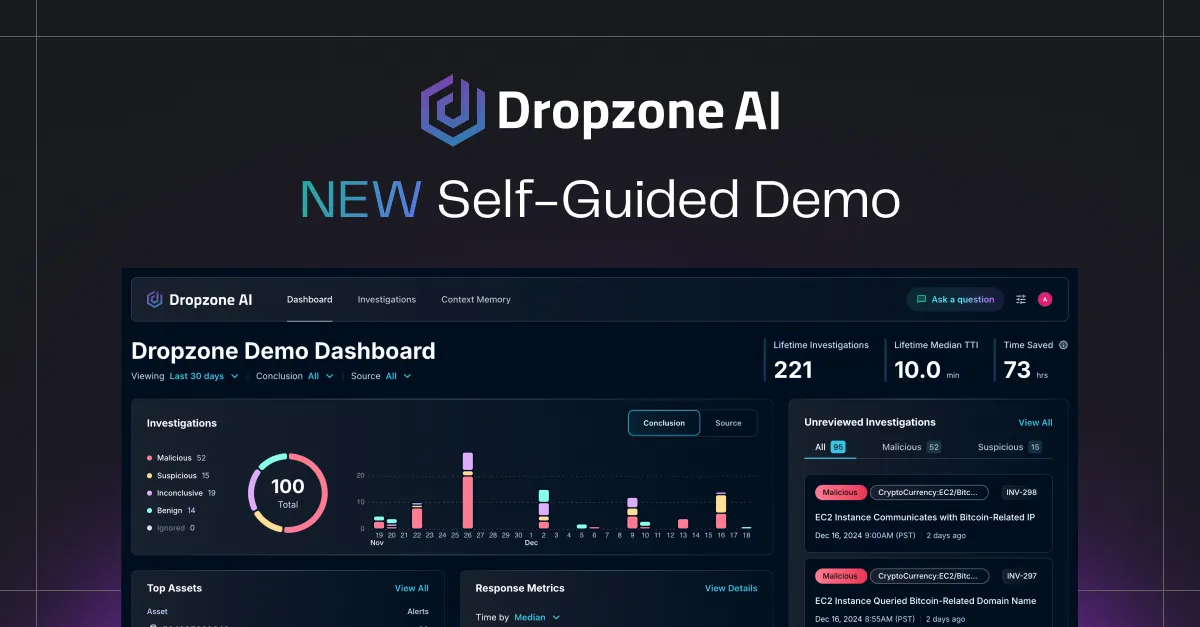
AI SOC isn't a replacement for human judgment; it amplifies it, giving teams the scale, clarity, and reliability they've been trying to achieve for years. If you want to see how this works end-to-end, you can walk through it yourself in our self-guided demo.
Key Takeaways
- SOC teams are overloaded, and manual investigations slow everything down. Real organizations are struggling to keep up with alert volume and limited staffing.
- AI can investigate alerts the way a human would, just much faster. Teams saw significant drops in MTTR, fewer alerts needing manual review, and far less noise.
- 24/7 coverage becomes realistic without hiring more analysts. Companies like Pipe and Lemonade now get consistent overnight investigations without expanding on-call staff.











.png)