

Introduction
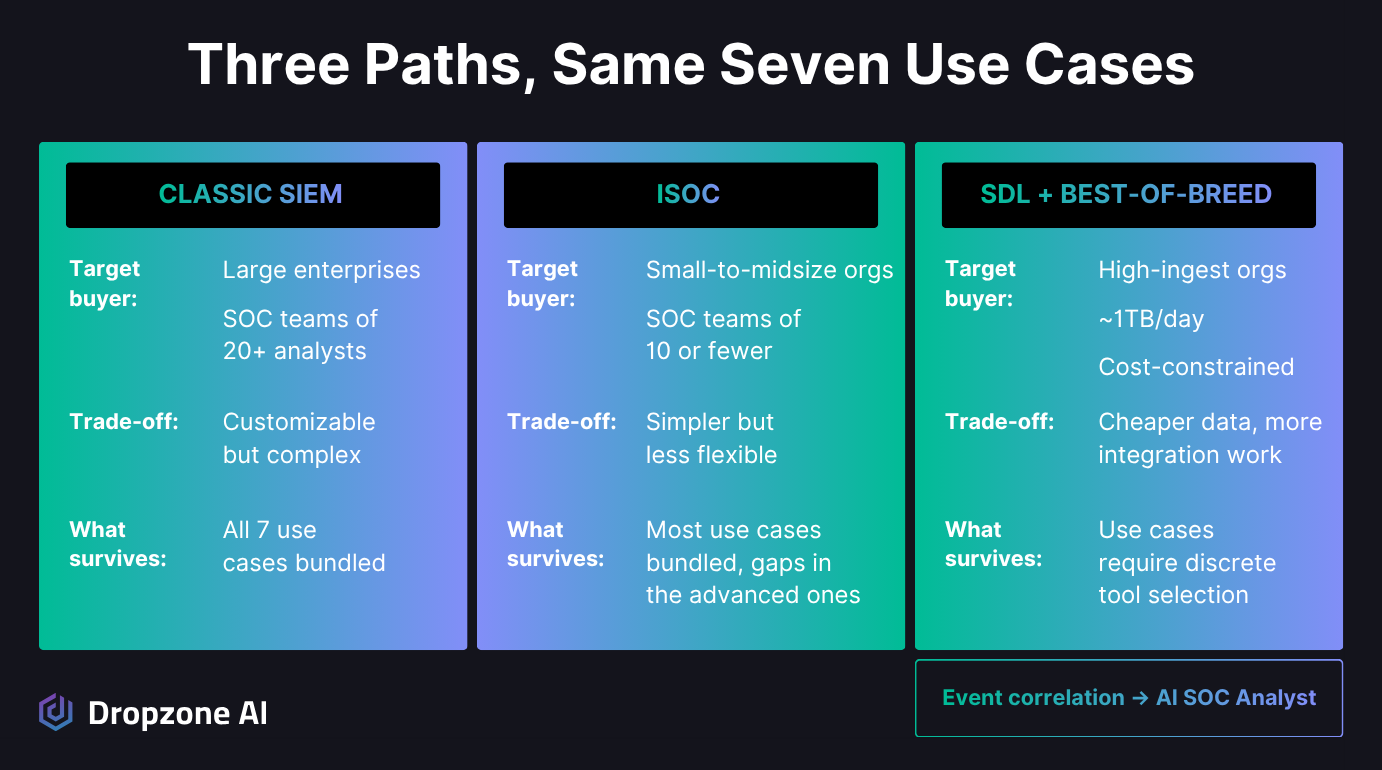
If you're evaluating a SIEM alternative, you've likely already noticed the bill climbing and the architecture options multiplying. Your team's appetite for another vendor migration is finite. Gartner's 2025 research describes the SIEM market splitting three ways: classic SIEM, integrated SOC, and security data lake plus best-of-breed. Which option will work best depends on the size and sophistication of your team.
Which SIEM Alternative Architecture Is Right for Your Organization?
Most teams evaluating a SIEM alternative end up weighing three architectures. Gartner's 2025 research on SIEM market evolution outlines all three, and your renewal conversation likely maps to one of them, whether you've named it yet or not.
Where Buyers Land Today
Each path is a real buyer's answer to a real pressure:
- Classic SIEM. Still dominates for large enterprises, the kind of security operations teams that run twenty or more analysts. These buyers prize extensibility, role-based access, and architectural support for complex, customizable detection content.
- Integrated SOC (ISOC). Bundles ingestion, correlation, basic SOAR, and case management into a more opinionated stack, trading some customization for simplicity and faster time to value. The target buyer is a small- to midsize organization with a security ops team of 10 or fewer who would rather get something working than tune it forever.
- Security data lake (SDL) plus best-of-breed. Optimized for organizations approaching 1TB per day of ingest. Your data lives in the lake (Snowflake, Databricks, or similar), and you assemble specialized tools around it for each use case rather than buying one bundled platform.
Where AI SOC Analyst fits in each of them is what the rest of this piece covers.
Seven Jobs That Still Need Doing
Whichever SIEM alternative you pick, the underlying use cases still need homes. Gartner's 2025 SIEM research covers the same seven that have always defined the category.
- Log management and event monitoring
- Federated search
- Event correlation
- Threat hunting
- Insider threat, plus user and entity behavior analytics (UEBA)
- Workflow automation
- Investigations and case management
Classic SIEM bundles all seven into a single platform. ISOC bundles most of them, with gaps in the advanced ones. SDL plus best-of-breed requires selecting discrete tools per use case.
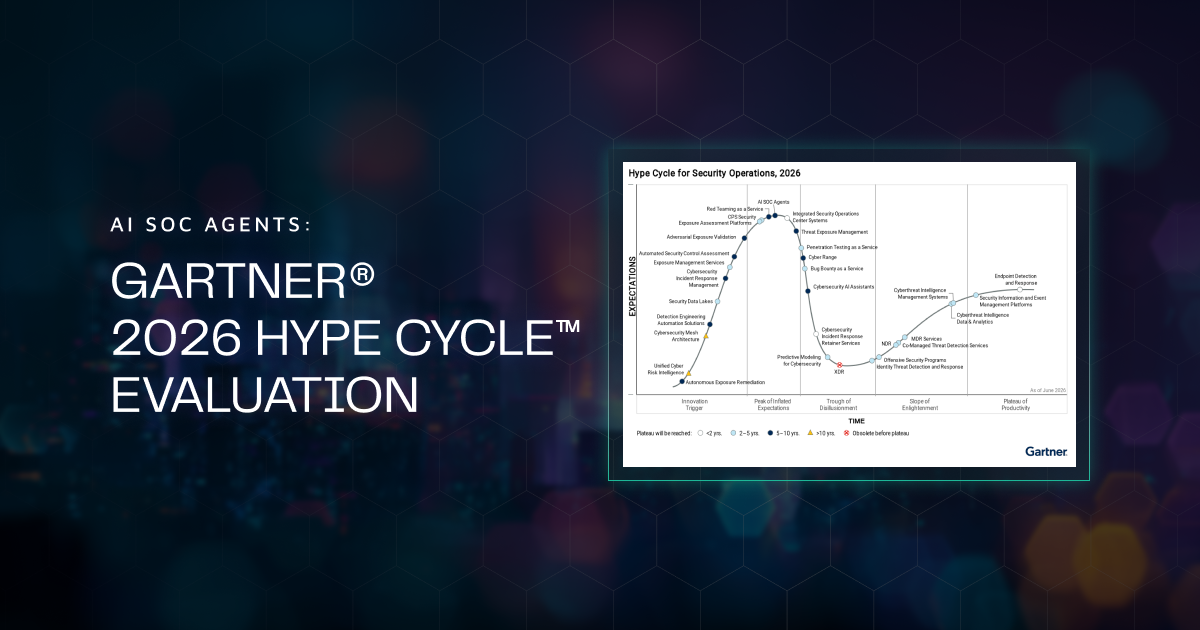
That's where an AI SOC agent gets named in the lineup. Gartner's evaluation guidance for SIEM alternatives suggests that you handle event correlation with AI SOC agents, and Dropzone is among the named examples.
How Does AI SOC Analyst Fit Into Each Architecture Path?
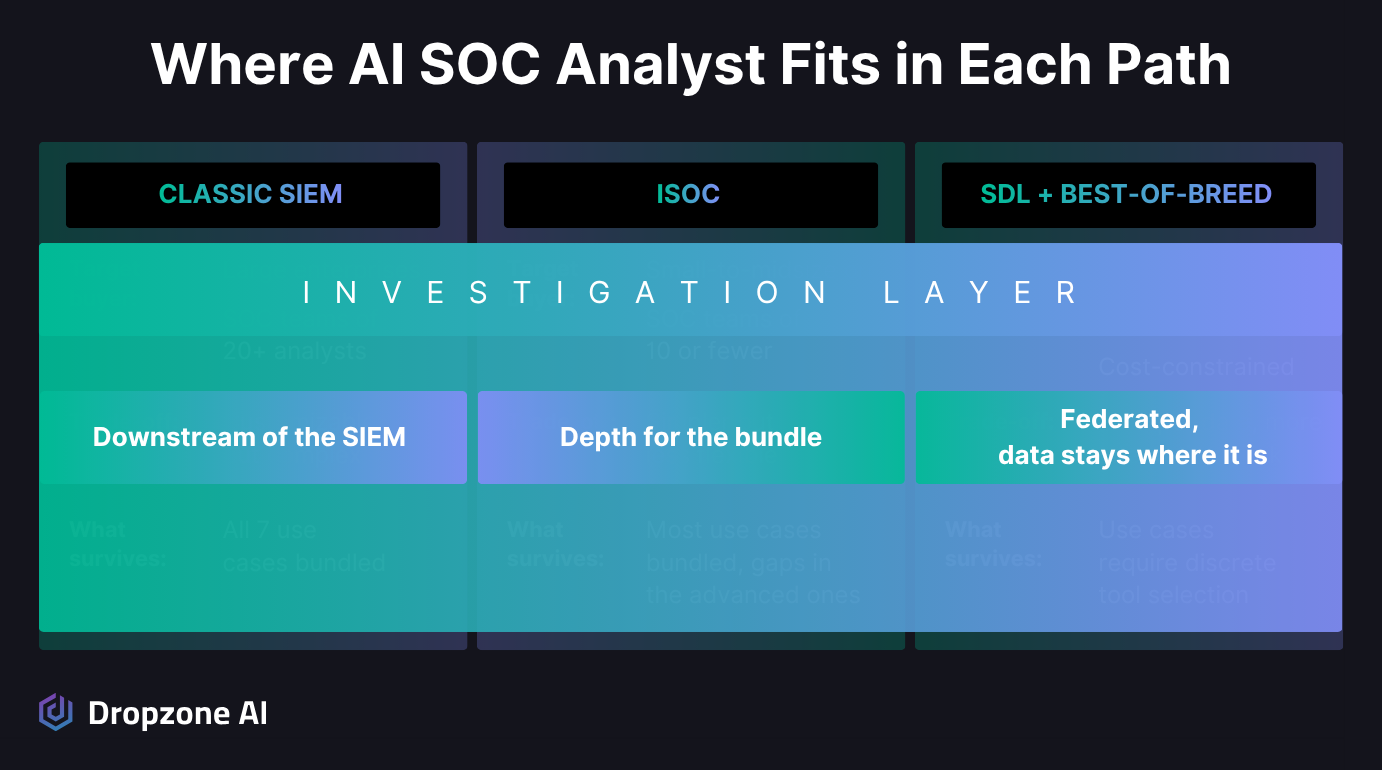
An AI SOC agents fits the same way in all three scenarios, because it works downstream of wherever your data lives. Here is what that looks like for each architecture, starting with a mature classic SIEM.
The SIEM Isn't Broken. The Queue Is.
A Fortune 500 enterprise running a mature classic SIEM stack (Splunk, Microsoft Sentinel, or QRadar) has tuned detection content over the years. The SIEM is doing exactly what it should: ingesting telemetry, applying correlation rules, and firing alerts on the results. Nothing about the SIEM itself is broken.
The bottleneck shows up downstream, where alert volume against analyst capacity is a math problem. Tier 1 analysts spend the day clearing tickets, while low- and medium-priority alerts are triaged out. The malicious activity that survives the longest tends to be the one that fired a low-severity alert which was skipped because nobody had time to look.
Dropzone's AI SOC Analyst sits downstream of the SIEM and investigates every alert with a consistently thorough investigation and a written conclusion in about seven minutes on average. Detection content stays where it is.
The SIEM contract doesn't change, but your SOC gets capacity back. The SIEM owns ingestion, correlation, and detection content; Dropzone owns investigation depth at scale. The two technologies are complementary.
ISOC Solves Triage, Not Investigation
At the other end of the spectrum, a six-person security team at a Series-C SaaS company (for example) runs an ISOC platform that handles ingestion, basic correlation, ticket workflow, and a starter case-management UI. The team moves fast, but every analyst is also covering other security tasks such as IT, compliance, and vendor reviews on the side.
Investigation is where ISOC bundles most often fall short. Triage flow is solid, and ticket routing works, but the depth of investigation is where the bundled AI reaches its limits. For a small team already stretched, that's the point in the day when alerts start sitting longer than they should waiting for manual review.
AI SOC Analyst integrates over the ISOC's surfaced alerts and adds the depth layer the bundle doesn't include. Part of that depth comes from how AI SOC Analyst learns your environment over time: it builds organizational context that gets more accurate as more alerts are processed. A vendor-agnostic AI SOC Analyst like Dropzone will also gather context from other sources that are not in the ISOC’s data store but would be part of a human analyst’s workflow, such as business systems, employee calendars, and interviewing the users themselves.
This depth of investigation matters most for the small-to-midsize teams ISOC targets. They can't manually investigate at the volume their ingestion produces, and an ISOC still leaves a lot of manual work to be done.
Leave the Data Where It Is
A 50-person SOC at an organization pushing 1 TB per day has hit the wall on classic SIEM cost per GB and is evaluating a Snowflake-based SDL with best-of-breed components plugged into it. This set-up improves costs and query speeds, but you need some add-ons.
This is where Gartner's 2025 SIEM research suggests an AI SOC Analyst for event correlation. The SDL model is simple in theory: keep data in the lake, select discrete tools for each use case, and control costs.
The catch most teams hit is that anything requiring correlated investigation across multiple data domains needs an investigation layer that can both query the lake directly and federate across the lake plus other contextual data still living in vendor-native stores or in data that’s in business systems.
AI SOC Analyst runs federated against your business systems (Microsoft Entra, Google Workspace, Jira, etc), EDR, identity, and network telemetry, regardless of whether that data made it into the lake.
Not every dataset needs to be centralized to be queryable, and the agent fetches what it needs from where the data lives to complete an investigation.
Does Your SIEM Alternative Choice Solve the Alert Backlog?
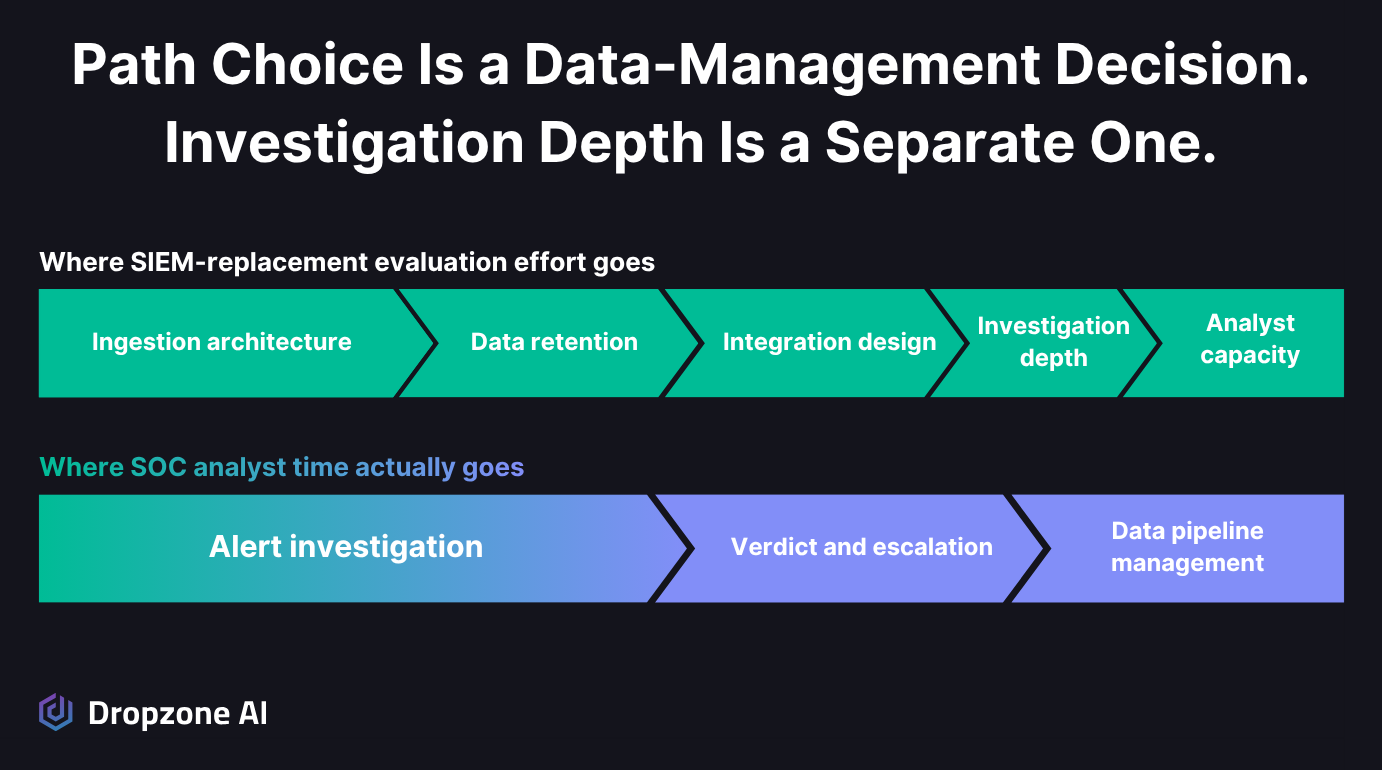
Gartner's three paths address a data management question, but they don't answer the alert investigation question. Regardless of where the bytes live, you need an AI SOC agent that’s able to gather the needed context to reach a confident alert investigation conclusion.
The investigation step (taking an alert from "fired" to "verdict" with confidence) is the same problem in all three paths. Same telemetry sources, same investigative reasoning, same false-positive challenges, same time cost per alert if a human is doing the work. An AI SOC Analyst operates above the data layer rather than inside it, which is why the architectural choice doesn't lock you in or out.
IDC's 2024 research on security buying behavior identifies alert volume management as a top-three operational challenge for security teams, regardless of the data architecture in use.
The investigation-capacity gap doesn't close because you picked a different data layer. A cheaper data architecture without an investigation-depth answer is still a SOC that can't clear its queue. A more customizable SIEM without one is the same SOC with a fancier query language. For a deeper look at how AI SOC Analyst reduces risk by cutting threat response time, the numbers make the bottleneck concrete.
Conclusion
The SIEM market splitting three ways is good news for buyers. No single architecture fits every organization, and it was never going to. Classic SIEM, integrated security operations center (ISOC), and security data lake (SDL) plus best-of-breed are all real answers to real buyer pressures. All three still need homes for the same seven use cases. Gartner's 2025 research identifies AI SOC analysts, including Dropzone, as the right fit for event correlation in the SDL path. But the same investigation layer works in the other two paths for the same reason: alert volume against analyst capacity is the SOC bottleneck in all of them, and that doesn't change when you change the data layer.
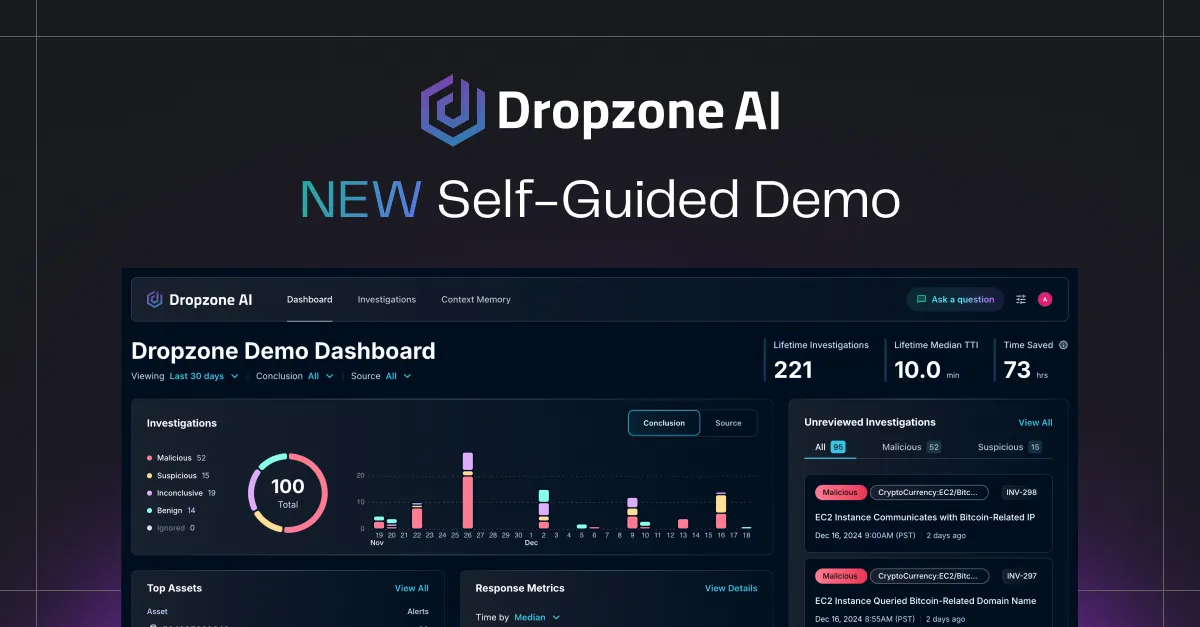
Walk through Dropzone's self-guided demo to see how AI SOC Analyst slots into the architecture you've already picked.
Key Takeaways
- All three SIEM alternatives solve a data problem, not the investigation problem. Classic SIEM, ISOC, and SDL plus best-of-breed each change where your data lives and how it gets managed. None of them changes how long it takes to investigate an alert.
- The investigation step is identical across all three. Taking an alert from "fired" to "verdict" uses the same telemetry, the same reasoning, and the same time cost per alert no matter which architecture you run.
- AI SOC Analyst sits above the data layer. It integrates downstream of classic SIEM, adds depth to ISOC bundles, and runs federated queries against an SDL, so the architecture you pick doesn't lock you in or out.







.png)