

Introduction
You are paying for security tools that your team never had the hours to fully enable. Organizations buy strong detection tools and then leave half their value sitting on the shelf, and when budgets are tight, every idle license is a number someone has to defend. The reflex is to cut tools, but the real problem is not the tools. It is that nobody has the time to operate them. In this article, you will see where that waste actually comes from, why buying more tools and bolting on copilots does not fix it, and how an autonomous AI SOC Analyst gets full value from the stack you already own.
You Own More Than You Use

Shelfware Is Draining Your Budget
Roughly 28% of per-user security software spend is underutilized or never used at all. That benchmark comes from Osterman Research, reported by CSO Online, and when budgets are tight, every idle tool becomes a visible cost. It is a long-standing reference point rather than a fresh measurement, but the pattern it describes has not gone away.
The problem keeps getting worse across software generally. Vertice reports that about 21% of the applications organizations pay for are no longer used, and another 45% are underutilized, meaning companies use fewer than half the licenses they bought. SaaS wastage rose 12% year over year, so the gap between what you pay for and what you use keeps widening.
For a CISO under consolidation pressure, the instinct is to cut tools, and some cuts are clearly justified. The trap is assuming the cut alone recovers the value. A tool you stop paying for still represents a capability you bought and never operated, and trimming the bill does nothing to close that gap.
More Tools Have Not Made You Safer
Piling on tools does not buy more protection, and the data suggests it can quietly cost you. According to the 2020 IBM Security and Ponemon Cyber Resilient Organization Report, enterprises run an average of more than 45 security tools. Organizations using 50 or more rated themselves about 8% lower at detecting attacks and 7% lower at responding than teams running fewer.
If more tools made teams safer, the most heavily tooled organizations would be leading on detection and response. They are trailing instead, which tells you the license count is not what separates strong programs from weak ones.
You feel this at the operational level too. Every added console is one more thing to integrate, tune, watch, and keep current, and analyst attention does not scale with the number of seats you license. So if the tools themselves are not the constraint, the obvious question is what is.
The Problem Is Not the Tools
Nobody Has Time to Run Them
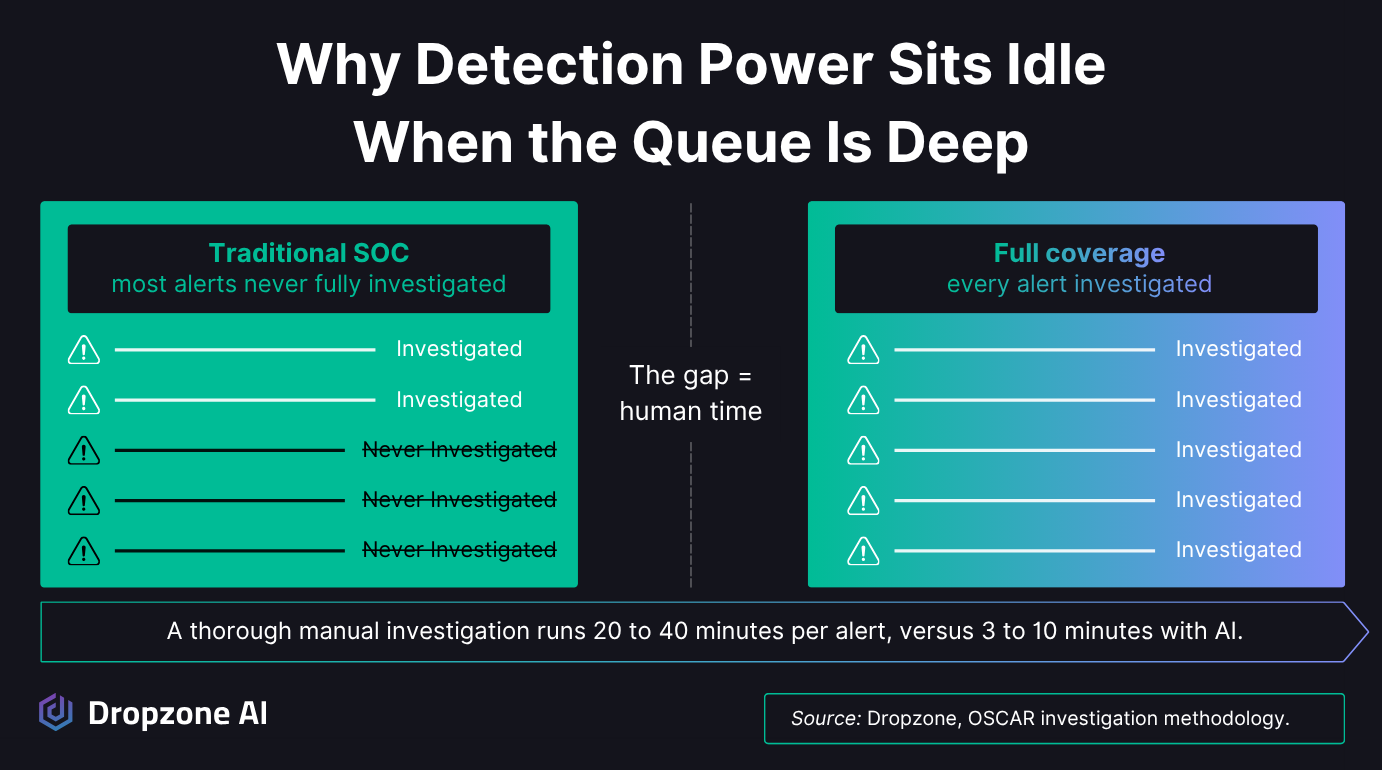
The detection tools are firing correctly; the failure point is that humans do not have the time to act on everything that fires, and operating a tool well takes hours that most teams cannot spare.
The same Osterman research that measured the shelfware also named the cause. Teams pointed to being too busy to implement what they had bought and too short-staffed to run it.
On a busy afternoon with a deep queue, lower-priority alerts get triaged away at a glance rather than investigated. The tool did its job; no one had time to follow through on each alert. You are not under-tooled in that moment; you are under-capacity, and that is a fixable problem that does not require another line item.
Copilots Still Need a Human Driver
Copilots and AI assistants bundled into existing tools genuinely help, but they do not close the capacity gap. A copilot speeds up an analyst who is still doing the work, and it stops after each small step to report back and ask what to do next, so if no one has the time to sit down and drive it through, the alert keeps waiting in the queue exactly as it did before.
Assistive AI accelerates a human at every step, which is useful, but it leaves that human as the rate-limiter for how many alerts ever get looked at. Buying tools because they "have AI now" repeats the original mistake if the AI still depends on scarce analyst hours to do anything.
Closing the gap takes a different kind of AI, one that operates the tools itself within boundaries a human sets and carries an investigation end-to-end without stopping to ask what to do next. Think of it as a human on the loop with oversight and direction, not a human in the loop on every click. That shift is what turns latent capability into actual coverage.
Turning Your Existing Stack Into Full Coverage
An AI SOC Analyst That Operates Your Tools Expertly
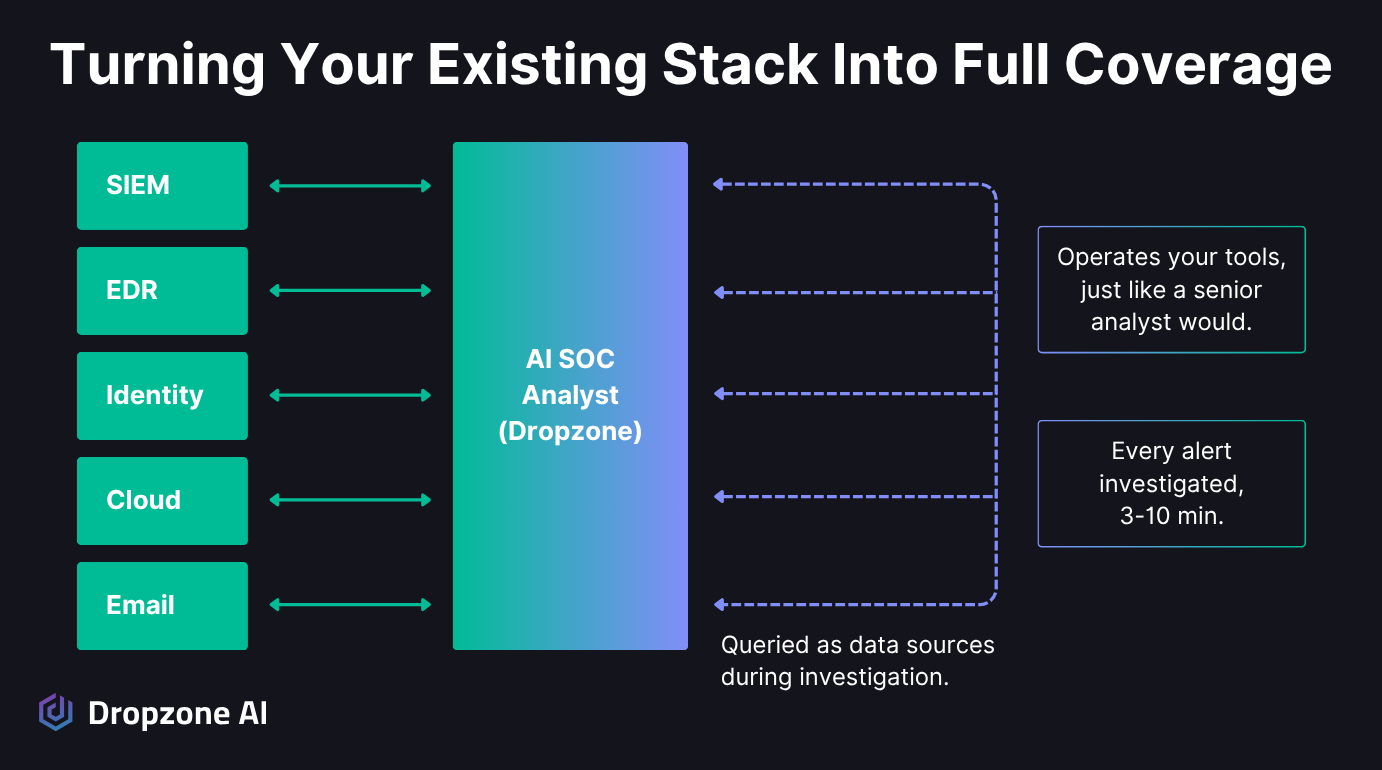
Dropzone is an agentic AI SOC Analyst that operates your existing tools at an expert level. It is vendor-agnostic across SIEM, EDR, cloud, identity, and email, with 90+ integrations, and it is pre-trained to use each one the way a senior analyst would, writing the queries, parsing the output, and navigating each console.
Because it is self-directed and acts within the boundaries you set, it does not wait for an analyst to drive it. That is what closes the capacity gap, because your human strategy directs the scope and authorization while Dropzone executes investigations at machine scale.
Every alert receives a thorough, consistent investigation following the OSCAR methodology, including low-priority ones that would otherwise be triaged away, in roughly 3 to 10 minutes rather than the 20 to 40 minutes a careful manual investigation demands.
None of this replaces your stack, and that matters. The SIEM stores and detects; Dropzone investigates what it surfaces; and it differs from SOAR, which automates enrichment and response playbooks without performing the investigative reasoning.
The results show up fast: ECS, ranked #2 on the 2024 Top 250 MSSPs list, scaled past 30,000 alerts per month through Dropzone, while Mysten Labs cut its alert-triage workload by 99%, with value delivered on day one and no log shipping or normalization required.
Your Tools Become Data Sources
The same expert tool used turns your underused tools into active contributors during an investigation, not just feeds that throw alerts over the wall. This is where the latent value you already paid for finally gets spent.
During an investigation, Dropzone queries your tools as data sources, the way a senior analyst would. It might check a threat intelligence source on a suspicious URL or IP, then call your cloud provider and directory services to pull user activity, metadata, and login history, stitching the picture together from across the stack.
Enabling more data sources enhances every investigation, much the way more institutional knowledge sharpens a human analyst, so the tools you pay for finally get used to their depth.
That same expert tool use carries into proactive work like threat hunts run across the existing stack, so the tools contribute there too, rather than sitting idle. And the financial case for letting AI do this investigative work is well documented. The IBM Cost of a Data Breach Report 2025 found that organizations that extensively use AI and automation saved nearly $1.9M per breach and shortened the breach lifecycle by about 80 days.
Conclusion
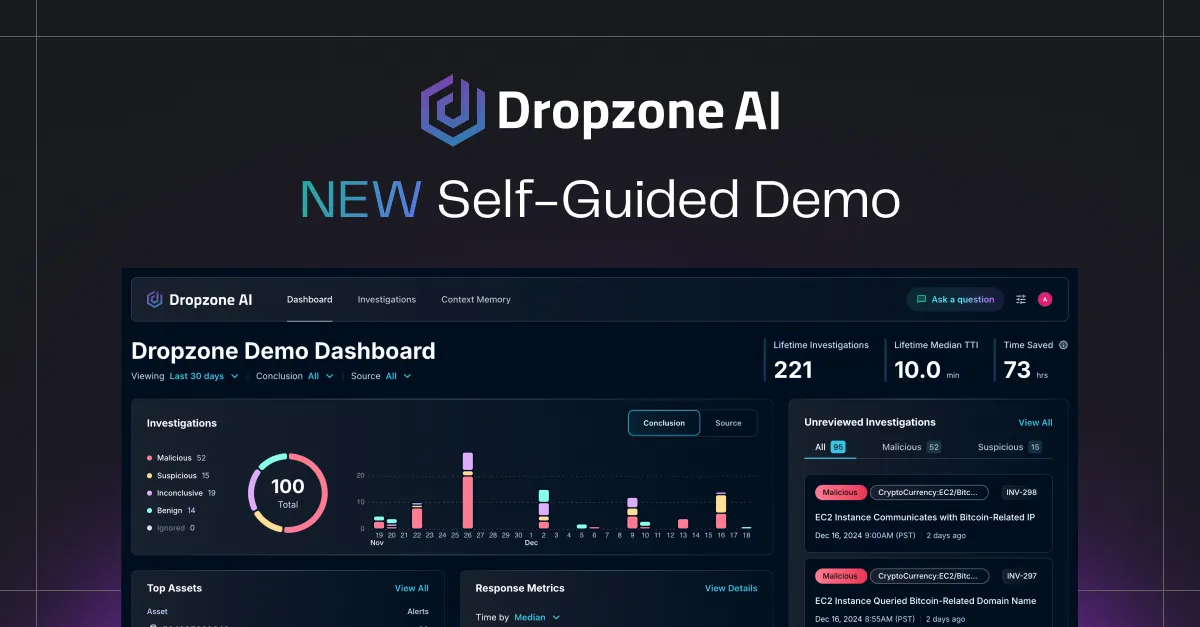
The waste comes down to the human hours needed to operate the tools, and that is the constraint an agentic AI SOC Analyst lifts. The payoff is more value from the spend you already committed, full coverage on every alert, and underused tools turned into active data sources, all without new spend or a rip-and-replace project. See it for yourself and walk through real investigations in our live, self-guided demo environment.
Key Takeaways
- Shelfware is real. Roughly 28% of per-user security software is underutilized or never used (Osterman Research), and organizations running 50+ tools rate themselves about 8% lower at detecting attacks (IBM and Ponemon).
- Human capacity. Detection tools fire correctly, but analysts lack the hours to act, so low-priority alerts get triaged away, and even built-in copilots still need a human to drive them.
- Dropzone operates it. An agentic AI SOC Analyst investigates every alert in minutes across your existing SIEM, EDR, cloud, identity, and email, then queries those same tools as data sources.








.png)