

Introduction
Threat hunting is the rare service your clients ask for by name and one of the few they will pay a real premium for. It is also one of the fastest ways for an MSSP to lose money. Every new hunting client pushes you toward another senior hire at around $235K, because the work has always scaled with headcount, your single biggest cost. Sell more of it, and the premium gets eaten by the labor behind it. In this article, you will see why the economics of threat hunting break for MSSPs, how automating the most time-intensive parts of the hunt lets you deliver it across more clients without scaling headcount, and how every hunt, even one that finds no attacker, becomes a deliverable you can put a price on.
Why Hunting Loses Money for MSSPs

Why Clients Want Hunting and Pay a Premium for It
You already price hunting as a premium tier, sitting above the baseline monitoring and alerting in your catalog, and your clients know they're paying more for it. Your clients keep asking for it by name because the threats they worry about most are the ones that never trip an alert.
A patient intruder moving quietly, an attacker after espionage or sabotage, rather than money, malicious activity, no detection rule was ever written to catch. Hunting goes looking for exactly that, instead of waiting for an alert to fire.
The work justifies the premium effective behavioral hunt queries take far more research than most people expect, according to the SANS 2025 Threat Hunting Survey, and writing them well leans on senior expertise. This is the service you most want to sell and the one your best clients most want to buy, which is exactly why protecting its margin matters.
Then Labor Eats the Margin
Labor is the single biggest line item for an MSSP, and hunting leans on the most expensive labor you have. Senior hunter compensation commonly runs from roughly $177K to over $300K, with senior roles averaging around $235K, according to Glassdoor.
That talent is scarce and costly; a third of organizations (33%) say they don't have the budget to adequately staff their security teams, the 2025 ISC2 Cybersecurity Workforce Study found, so the senior skills a hunting program needs are often out of reach even when the headcount is approved.
Staffing shortages are the number one barrier to a successful hunting program, as named by 61% of organizations in the SANS survey. So the obvious fix, hiring your way to more hunting capacity, is both expensive and frequently impossible.
Every new hunting client pushes you toward another senior hire, which means capacity scales linearly with payroll, and the premium you charge gets eaten by the labor required to deliver it.
How AI Threat Hunting Changes the Unit Economics
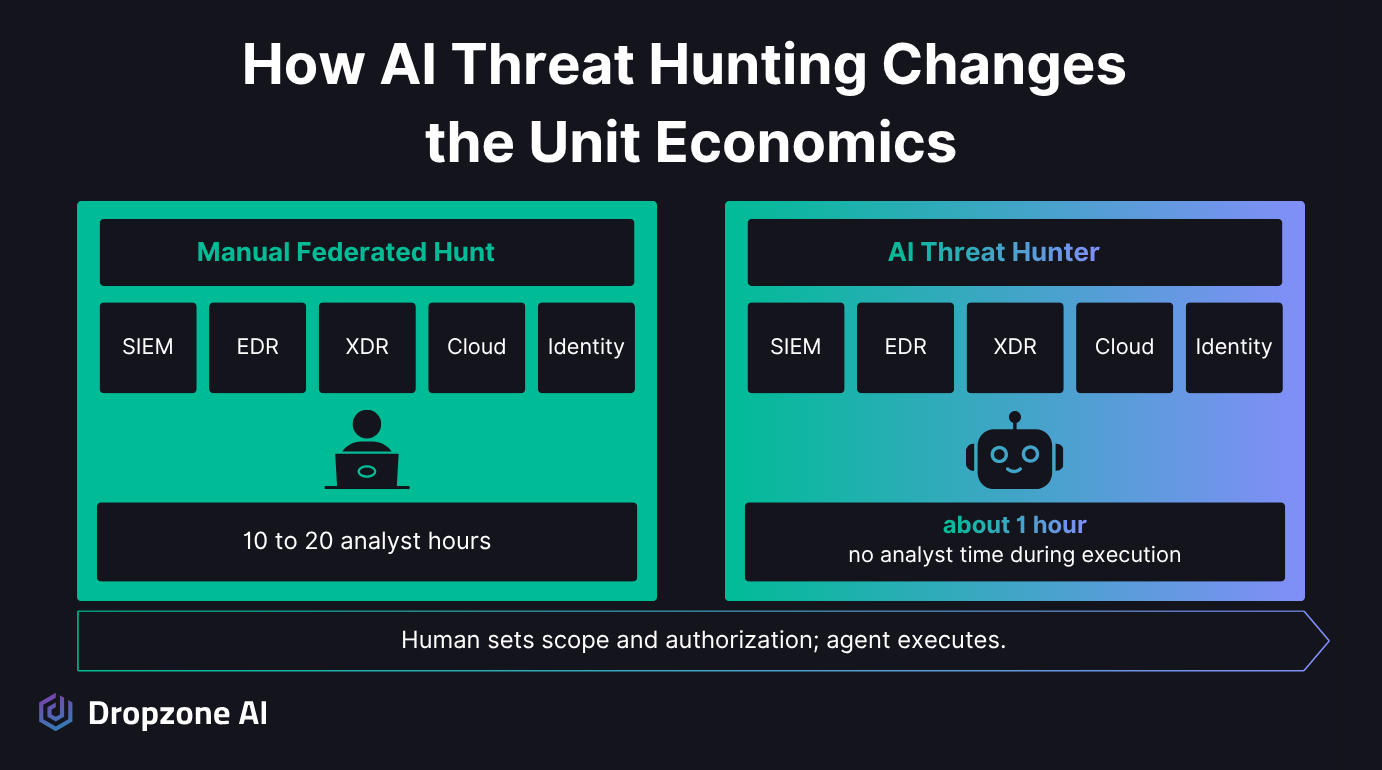
Let the Agent Do the Grind
Picture the manual version, where an analyst writes a query, runs it across a huge data set, waits, and gets back either nothing or a wall of noise, so they refine it and run it again. Every promising lead is another 10 to 20 minutes of hand-digging.
It is "hit the button, go get a coffee, come back," exactly the kind of work that should be automated. The AI Threat Hunter does it itself, casting a federated search across the client's SIEM, EDR, cloud, and identity tools at once and slicing up to half a million rows of telemetry from a single search down to the anomalies that matter, as the product page details.
It then runs dozens of deep-dive investigations in parallel to confirm which anomalies are real. A hunt that would take a human analyst 10 to 20 hours finishes in about an hour with no analyst time during execution, and because it is pre-trained to use each tool expertly, it works across the varied stacks MSSPs inherit from different clients without a per-tool ramp.
A Library of Hunts You Can Sell
The agent works from a library of pre-built hunt packs, so you are not writing hunts from scratch for every client. They span insider threat, cloud-first environments, Windows enterprises, remote and hybrid workforces, after-hours authentication anomalies, and the full range of MITRE ATT&CK techniques.
Most of these run as recurring audits rather than one-off investigations. A remote-services or protocol-tunneling hunt, for example, is something a client benefits from on a schedule, not just once.
That breadth is also a differentiator. Where other AI hunting tools tend to chase one named threat group at a time, the AI Threat Hunter runs across the full sweep of ATT&CK tactics, so you audit for the techniques attackers actually use instead of hoping a specific actor shows up.
More Clients, Same Bench
Instead of a quarterly engagement, an analyst can only run a few times a year; the agent hunts continuously, so hunting stops being episodic and becomes an always-on coverage tier you can package and sell.
Dropzone runs each client in a dedicated tenant with strict data isolation, so you can onboard new clients and run hunts across them without one client's data touching another. Capacity scales with the tool, not the size of your hunting bench.
The AI Threat Hunter operates in a closed loop with the AI SOC Analyst and the AI Threat Intel Analyst as part of the Agentic SOC, so hunt findings feed investigation and threat intel without a manual handoff.
As MSSP Alert has argued, AI-driven SOC tooling enables providers to serve materially more clients without a proportional increase in headcount, shifting the model toward software economics. Humans still direct scope, authorization, and business context while the agents execute, staying on the loop rather than blocking the critical path.
Why an Empty Hunt Is Still a Sellable Deliverable
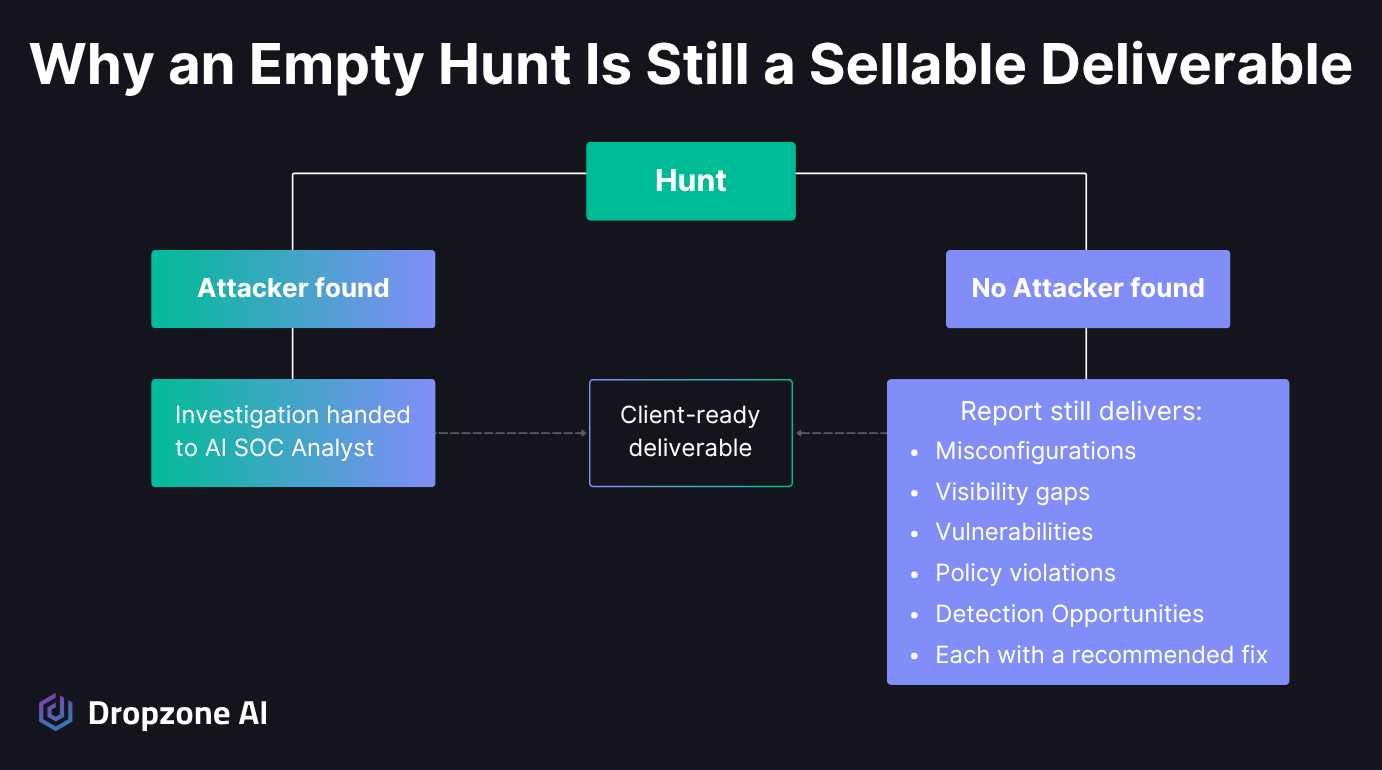
Finding Nothing Is a Finding
A hunt that turns up no attacker is often a sign of a healthy, well-secured environment. A negative result is a valid, meaningful finding, not a dead end, and it confirms your controls held against the threat model you tested, as SANS lays out in its work on threat hunting and false negatives.
It also fixes a real measurement problem. Only about half of organizations formally measure hunting effectiveness, and a growing share don't measure it at all, the SANS survey found, making it genuinely hard for most teams to demonstrate the value of a quiet hunt.
An empty hunt also exposes where you can't see, highlighting gaps in data visibility or monitoring coverage that make the case for expanding instrumentation. If every hunt produces a concrete written result, you can justify the invoice whether or not an attacker was present, and that's what makes recurring hunting revenue durable.
Every Hunt Is an Audit
Beyond attackers, every hunt doubles as an audit of the client's environment. It surfaces misconfigurations such as weak segmentation, overly broad access, and default credentials, as well as policy violations, unpatched vulnerabilities, and detection opportunities where a new rule would pay off.
Uncovering visibility gaps, the blind spots where you have no telemetry, is one of the most common payoffs of hunting, per the SANS 2025 Threat Hunting Survey. The agent writes each one up with a recommended fix and packages it into a client-ready report, so you hand over remediation guidance and detection recommendations rather than a dead end. That audit gives you something concrete to show for every engagement, attacker or not.
Because the AI Threat Hunter works in that closed loop, findings that warrant deeper investigation flow straight to the AI SOC Analyst, and emerging-threat context comes back from the AI Threat Intel Analyst. Most hunts become an upsell surface, since a surfaced misconfiguration or visibility gap is a remediation conversation and often the seed of an expanded engagement.
Conclusion
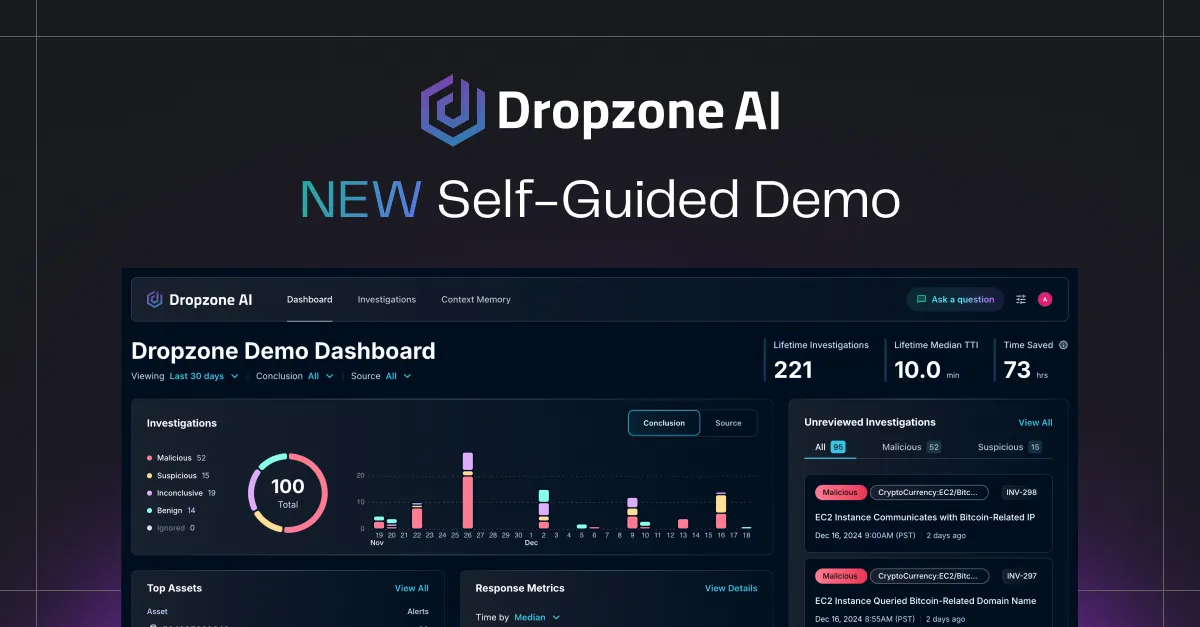
So the question stops being whether you can afford senior hunters and becomes how many clients you can put under continuous coverage with the bench you already have. Automating the most time-intensive parts of the hunt resets the cost side, ensures continuous coverage, and ensures that every hunt produces something sellable. The AI Threat Hunter is now in early access, with general availability coming in Summer 2026. See it for yourself and walk through real federated hunts and investigations in the self-guided demo, no meeting required.
Key Takeaways
- Premium, but unprofitable. Threat hunting is one of the most sought-after services an MSSP can sell, yet the unit economics break because senior hunters run around $235K, are scarce to hire, and the work is deeply labor-intensive.
- One hour, not twenty. Dropzone's AI Threat Hunter runs federated, hypothesis-driven hunts across a client's existing stack in about an hour rather than 10 to 20 hours, and runs them continuously, so you can serve more clients without adding headcount in lockstep.
- Every hunt is an audit. A hunt that finds no attacker still surfaces misconfigurations, visibility gaps, vulnerabilities, and detection opportunities, each with a recommended fix, which is how you defend the price of every hunt.








.png)