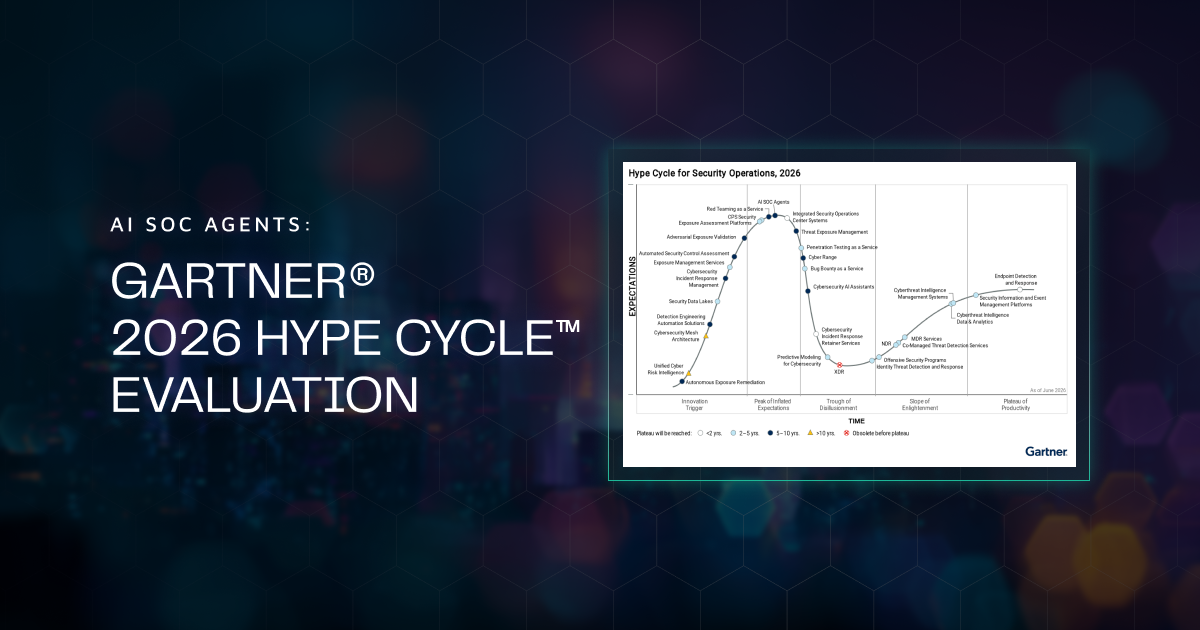

Most years, we felt that a Gartner® Hype Cycle™ reads like an update: a few technologies climb, a few mature, the curve advances. The 2026 Gartner Hype Cycle for Security Operations reads differently in our opinion. Gartner describes an industry defined by "massive structural corrections and a significant influx of innovations," an industry that is not evolving so much as aggressively changing course.
For security operations directors and CISOs, that means more vendor noise, a threat landscape moving faster because attackers are using AI too, and real pressure to retire architecture that no longer scales. Here is what actually changed this year, where AI fits, and how to tell a proven capability from a well-marketed promise.
An industry correcting course: three structural shifts
Gartner groups this year's movement into three themes. The one most teams feel first is the redefinition of the SIEM.
The traditional SIEM market is splitting. Alongside classic SIEM, two alternatives have established themselves:
- Integrated security operations center (ISOC) systems offer unified detection, investigation, and response from a single vendor, with high out-of-the-box value and a faster time to value than a traditional SIEM build. Consolidated platforms such as CrowdStrike's NG-SIEM and Palo Alto Networks' XSIAM illustrate the approach buyers now weigh against the classic model.
- Security data lakes (SDL) give teams a more cost-effective, flexible way to store and retain data, easing the old SIEM dilemma of ingesting too much and paying for it or ingesting too little out of fear of the bill.
The same correction is reshaping XDR. As large platform vendors absorb XDR as a feature layer inside broader offerings, Gartner notes the "XDR market movement toward obsolete before plateau." The capability is not disappearing, it’s just getting absorbed into larger platforms. For leaders, the practical take-away is to stop evaluating XDR as a separate purchase and start expecting it as part of a platform.
We also see two further shifts described in the report:
- Vulnerability management continues its move into continuous threat exposure management (CTEM), shifting from point-in-time discovery toward continuous, threat-led validation.
- Threat intelligence is getting a makeover, as teams move past raw indicator feeds toward curated, contextualized intelligence managed in dedicated systems.
AI takes center stage: two categories every SOC leader should understand
AI is moving from assistance to autonomous action. In the new Hype Cycle report, Gartner notes that "expectations for artificial intelligence are rapidly pivoting from passive assistance to unproven, yet limited, autonomous capabilities." Two adjacent profiles on the Hype Cycle capture that advancement, and they are easy to confuse.
The first is Cybersecurity AI Assistants: the generative AI features now embedded in the tools you already own. Describe what you want in natural language instead of writing a query, surface the alerts that matter, get a suggested next step. These features are useful, but bounded. Gartner explains the core limitation: "Cybersecurity AI assistants' scope is often limited to the product they're part of, creating fragmented insights and limited value." Of note for any buyer: Gartner observes that many features marketed as "AI agents" today actually belong in this assistant category.
The second is AI SOC Agents. Whereas an assistant lives inside one product, an AI SOC agent is vendor-agnostic and works across the tools in your stack. Gartner defines the category as using AI to augment common security operations activities: investigation through natural-language query, false-positive reduction, alert enrichment, attack-path contextualization, reporting summarization, and next-step advisory. This category debuted in the 2025 Hype Cycle in the Innovation Trigger phase and now sits at the Peak of Inflated Expectations. That climb reflects attention, not maturity. Attention and proof are not the same thing, which is where we come to “AI washing.”
Dropzone AI is listed as a Sample Vendor for AI SOC Agents in the 2026 Gartner Hype Cycle for Security Operations, the second consecutive year.
The credibility problem: AI washing
A category at its peak attracts hype, and Gartner spends real space warning about it. Across the report, the analysts caution buyers four times about "GenAI washing," "AI washing," and "agent washing," and ask readers to be skeptical of vendor claims.
In plain terms, agent washing is attaching the words "AI agent" to any feature that uses AI regardless of whether that feature has true agency or not. Building a simple agent is easy now; off-the-shelf agent builders make a basic prototype a short exercise. Building one reliable enough to be accountable for security outcomes is a different discipline entirely, because a person still is accountable for the result at the end of the day.
That accountability is important. For an AI SOC agent, the worst-case failure is a false negative: an investigation that concludes a real threat is benign. Gartner's guidance on testing vendor claims is as follows:
- Rigorously pilot emerging capabilities to separate hype from operational reality.
- Demand transparency into how the system reaches its conclusions.
- Do not pay a premium before you have measurable results against your own baseline.
A buyer's checklist: what "real" looks like
We’ve been involved in many enterprise evaluations of AI SOC agent products. Here are some things to look for when separating real capabilities from agent washing.
Ask about a systematic QA program. A vendor that controls quality deliberately can tell you how it measures and maintains investigation accuracy over time. Dropzone treats this as an engineering discipline; read about our quality assurance process.
Ask for transparency and evidence. You should be able to see what the system did and why, not just the verdict it reached. Dropzone exposes an Action Graph, detailed findings, and an evidence locker, the kind of full audit trail that governance, compliance, and post-incident review depend on.
Ask how it replicates expert human techniques. A reliable agent should investigate the way a strong analyst does, recursively reasoning and improving (when called for) and not following a rigid process. Dropzone maps its alert investigations to OSCAR, an established investigative methodology.
Ask how it gets all the context needed. Most moments of "the AI got it wrong" are because of missing context, not a hallucinating model. The robust context engineering is what lets an agent reach the same conclusion a good analyst would. Dropzone's engineering team treats this as a core problem; read our take on the critical importance of context engineering.
The takeaway
In our view, the 2026 Gartner Hype Cycle is a snapshot of an industry rearranging itself, with AI as the engine of most of the new innovations. Savvy cybersecurity leaders will be the ones who pilot deliberately, demand proof, and operationalize what survives contact with their own environment.
Read the complimentary Gartner Hype Cycle for Security Operations, 2026








.png)