
Introduction
MSSPs scale alert investigations by handing the investigation layer to AI SOC analysts, AI agents that work every alert end to end and return a verdict backed by evidence. SOAR keeps the job it is good at, executing policy-based response actions. The work playbooks were never designed to carry, reading user behavior, chasing multi-step attack chains, weighing historical context across a client's stack, is what the AI agents absorb.
The economics matter as much as the technology. Every client you onboard adds alert volume, playbook variants, and SLA exposure, and margins depend on not hiring one analyst for every new contract. ECS, a top-5 MSSP in North America, sends 30K alerts a month through Dropzone. The sections below cover where SOAR strains under multi-tenant load, what AI SOC analysts investigate that playbooks cannot, and what the shift does to analyst utilization, SLA consistency, and margin.
The Limitations of SOAR for MSSPs
Challenges with SOAR Playbooks
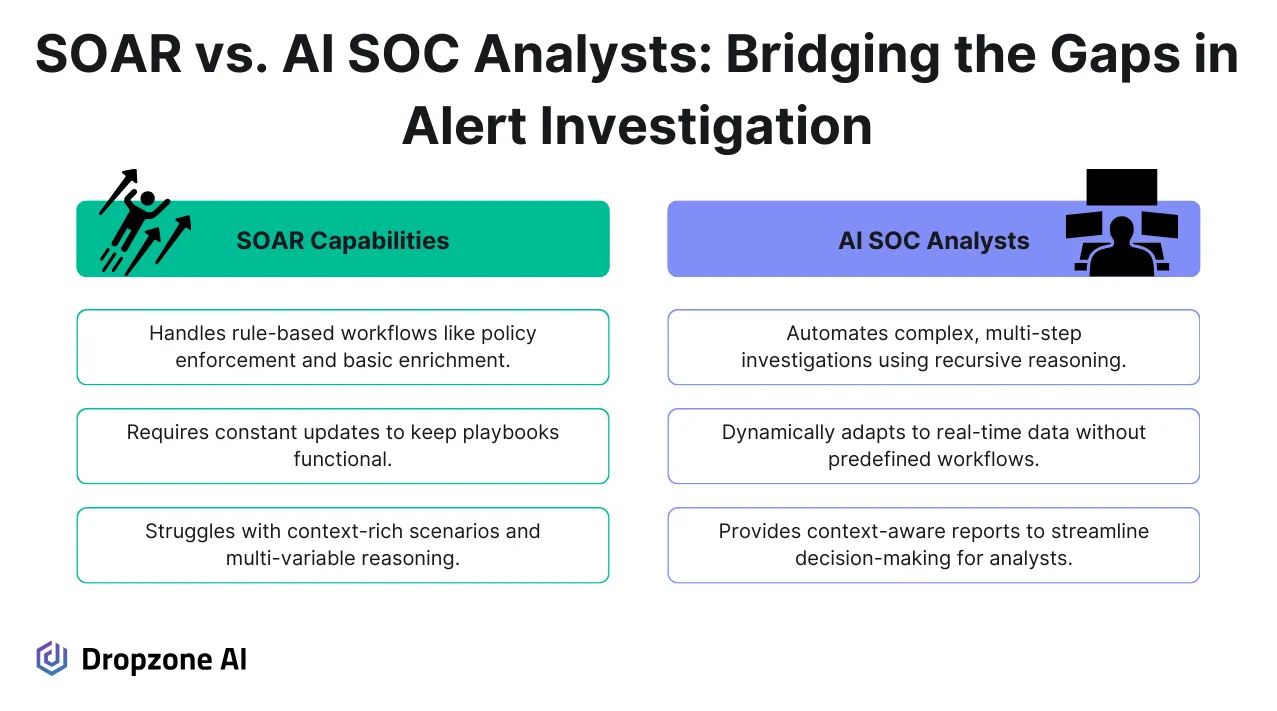
SOAR playbooks automate structured, rule-based work, and they are still good at it. When the trigger condition is unambiguous, blocking an IP after a confirmed malware signature, suspending an account that violates an access policy, a playbook executes the response faster and more consistently than a person. If you can write the activity into a client's policies, it is probably still a good SOAR candidate.
The MSSP problem is multiplication. A playbook tuned for one client rarely transfers cleanly to the next. Different SIEMs, different log sources, different policies, different definitions of normal. Supporting 50 clients can mean maintaining 50 variants of the same workflow, and every detection change inside any one environment creates drift somewhere in that library. Playbook maintenance becomes a permanent engineering tax that grows with the client roster.
Investigation is the deeper limit. An alert that cannot be resolved with an "if X, then do Y" rule needs someone, or something, to read user behavior, access patterns, and historical activity in context. Playbooks were not designed for that work, so the alert falls back to a human queue.
Impact on MSSPs
For an MSSP, those gaps land on the three numbers that decide whether growth is profitable.
Analyst utilization. Every alert a playbook cannot resolve falls to a human analyst, and most of that fallback work is repetitive evidence-gathering rather than judgment. Senior analysts end up spending their hours on tier-1 lookups instead of the threat hunting, onboarding, and tuning work clients actually notice.
SLA consistency. Manual queues are volume-sensitive. A quiet Tuesday and a noisy Saturday night produce very different response times from the same team, and contracted SLAs do not flex with the queue. The deeper the manual investigation backlog, the closer every alert spike pushes the service to its commitments.
Margin per client. When investigation capacity comes only from headcount, every new contract carries a hiring shadow. Alert volume grows with each onboarded client, but revenue does not scale with the labor needed to work that volume manually. Growth that adds cost as fast as it adds revenue is the squeeze most service providers are trying to escape.
AI SOC Analysts: A New Frontier in Alert Investigation Automation

How AI SOC Analysts Go Beyond SOAR Capabilities
AI SOC analysts automate the investigation itself, not just the enrichment steps around it. Where a playbook executes a fixed decision tree, an AI agent works the alert the way a trained analyst would, following an investigative methodology like OSCAR. Dropzone AI's agents do this through recursive reasoning. The agent forms a hypothesis about the alert, runs lookups across the connected tools, reads what comes back, and decides what to check next, repeating until it can deliver a verdict with the evidence attached.
Your analyst gets a concluded position instead of a half-enriched alert. Confirmed threats arrive escalated with the full evidence trail attached. False positives arrive as documented verdicts an analyst can confirm in minutes rather than rebuild from scratch. The specific investigative steps are in the list below, and they run the same way for every client on the roster.
This is the shift from SOAR to the agentic SOC model playing out inside service providers. Investigation moves to AI agents while response authority stays with people. And SOAR does not have to leave the stack. For MSSPs that keep it for response execution, how AI SOC analysts integrate with SOAR covers the coexistence pattern in detail.
Advantages for MSSPs
You deal with alerts that don’t always fit into a predictable pattern. AI SOC analysts handle those cases automatically. They analyze complex, low-frequency alerts that SOAR can’t process, performing investigative steps that go beyond basic enrichment, such as:
- Pulling data from SIEMs and security tools to gather logs and relevant telemetry.
- Checking user authentication patterns to detect unusual or suspicious activity.
- Investigating recent changes to user accounts or permissions for signs of privilege misuse.
- Tracing process trees to identify and analyze malicious execution attempts.
- Validating file hashes against threat intelligence feeds to confirm known threats.
- Looking up domain and IP reputations to assess potential malicious connections.
AI SOC analysts deliver structured, in-depth reports so your team gets the necessary context before deciding to escalate an alert to a client. No more chasing down missing details or manually pulling logs from multiple platforms. Every investigation includes past user behavior, correlation with similar events, and a clear summary of what happened, why it matters, and what action to take. This speeds up your response time and gives your clients the confidence that every alert is handled thoroughly.
Use Cases
Dropzone AI has a number of MSSP customers that rely on our AI SOC analysts to handle repetitive, routine alerts, especially phishing alerts and suspicious login alerts.
Let’s say you receive an Okta alert for a suspicious login. With SOAR, you might enrich the alert with geolocation and threat intel, but if it still looks suspicious, an analyst has to dig further. An AI SOC analyst handles the full investigation for you. It retrieves firewall logs, endpoint telemetry, and identity data, checking whether this login is part of a larger attack.
Instead of escalating an incomplete case, AI provides a fully documented analysis, identifying whether this is a one-off anomaly or part of an active threat. Your analysts can then confidently take action immediately. See exactly how this works in our Okta Alert Investigation product tour.
Business Impact of AI-Driven Alert Automation
Scalability Without Compromising Quality
Multi-tenant volume is the test that breaks headcount-only scaling. Alert flow grows with every client added, and headcount cannot grow at the same rate. AI SOC analysts absorb the investigation layer of that growth. Every alert gets investigated end to end on arrival, whatever the hour and whatever else is in the queue, and your analysts work from concluded verdicts instead of raw alerts.
Dave Howard, Senior Director of Cybersecurity Operations at ECS, put the economics plainly in the ECS case study:
"Matching alert growth with linear headcount simply isn't viable. We can't add alerts and add full-time employees one-for-one. Dropzone allowed us to scale our analysts' impact without replacing the people who make our SOC effective."
The 24/7 effect matters as much as the volume effect. Investigation quality from a human bench varies with shift depth and queue load. An AI agent investigates the 3 a.m. alert with the same depth as the 3 p.m. one, which is what makes around-the-clock SLA commitments sustainable without senior staffing in every time zone.
Enhanced Service Offerings
No two client stacks match. SIEMs, EDRs, identity providers, and cloud platforms differ from contract to contract, and your service has to investigate well in all of them. Dropzone AI's agents come pre-trained on the tools security teams run, with 90+ integrations across the stack, so an investigation follows the same evidence trail whichever tools sit underneath it.
The agents also learn each client environment and keep that context. Past investigations, normal login behavior, and recurring benign events stay attached to the client instead of leaving with whoever worked the last ticket. Jesse Mainor, SOC Manager at ECS, on what that looks like from the receiving end:
"We were surprised by the depth of the investigations. Dropzone was pulling in context and evidence that our analysts wouldn't normally gather during initial triage."
Depth that does not vary with queue load is what consistent service quality actually means, whether you are managing ten client environments or a hundred.
Cost Efficiency and Profitability
Service-provider margin is a utilization problem. Hours spent on repetitive tier-1 investigation are hours the business pays for but clients barely see, and they are the same hours that drive the burnout behind analyst turnover. Across deployments, Dropzone AI customers report an average 95% reduction in manual alert investigation, and that recovered time is the margin lever.
Chris DeBrunner, VP, Security Operations at CBTS, describes where the time goes in the CBTS case study.
"We've seen a huge reduction in repetitive work. Dropzone has offloaded about 30–50% of our alert volume. That's time we can now spend threat hunting, onboarding customers, or improving coverage."
That is the margin mechanism in one quote. Investigation capacity stops scaling with headcount, each new MDR contract adds less labor cost than it used to, and the senior hours you already pay for move to onboarding, threat hunting, coverage tuning, and the client-facing work that wins renewals. Read more about how Dropzone AI works with MSSPs.
Conclusion
SOAR keeps its place in an MSSP stack as the response-execution layer. What it cannot do is investigate, and investigation is where multi-tenant scaling breaks. AI SOC analysts close that gap. They investigate every alert end to end, return evidence-backed verdicts your analysts can act on, and hold the same depth across every client environment, which is what turns alert growth back into profitable growth.
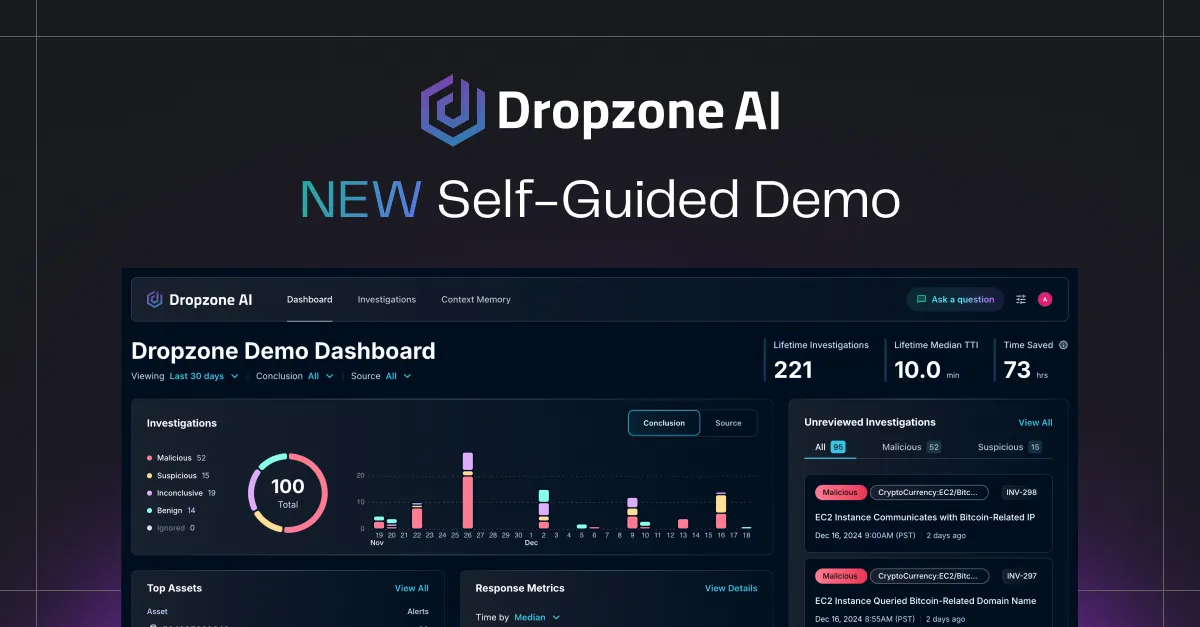
See the AI SOC Analyst work a real alert in the self-guided demo, or download our MSSP solution brief for the service-provider detail.








.png)