
The most realistic path to 24/7 SOC coverage in 2026 is an operating-model change, not a bigger night-shift budget. AI SOC agents investigate every alert as it arrives, around the clock, and deliver a verdict backed by evidence. Your analysts respond to confirmed threats on their own schedule instead of watching a queue at 3 a.m.
The staffing math explains why so few teams ever get there with people alone. Keeping one analyst seat covered around the clock means a bench of people rotating through nights, weekends, holidays, vacation, and turnover, and most security budgets cannot carry that bench. The coverage gap lands in exactly the hours attackers prefer.
This guide treats 24/7 coverage as the operating-model problem it is. It walks through the staffing models SOCs run today (shift rotation, follow-the-sun, on-call, outsourced), where each one breaks, and how AI SOC agents change the coverage math.
Why 24/7 SOC Coverage Is an Operating-Model Problem
24/7 SOC coverage means every alert gets investigated within minutes of firing, at any hour of any day. It does not mean humans watch dashboards all night. Holding that standard with people alone is what most teams cannot afford, and attackers know it.
Adversaries schedule around staffing. CISA and the FBI have warned that ransomware operators favor weekends and holidays, when response is thinnest. The pattern is old enough to have a textbook case. In the Bangladesh Bank heist, attackers timed fraudulent transfer requests to land across the bank's weekend and a holiday, and the delay in detection gave the operation its running room.
Detection tooling is not the gap. Your stack already fires alerts at 3 a.m. The gap is what happens next. An alert that waits in a queue until the morning shift arrives behaves, for the attacker's purposes, like an alert that never fired.
That makes around-the-clock coverage an operating-model question rather than a tooling question. Who, or what, investigates the alert the moment it lands, and who responds when it turns out to be real?
The Four Staffing Models for 24/7 Coverage, and Where Each Breaks
Teams that try to hold around-the-clock coverage run some version of four models. Each works on paper. Each breaks somewhere specific.
In-House Shift Rotation
Three shifts a day, every day of the year. Covering one analyst seat around the clock takes a bench of people once nights, weekends, vacation, sick time, and training are accounted for, and the night seats are the hardest to fill and the fastest to empty. The cybersecurity talent market has carried a persistent shortfall for years, so backfilling a night-shift departure can take months. Rotating schedules disrupt sleep and home life, alert fatigue makes the quiet hours heavier instead of lighter, and the staffing strain compounds the other SOC challenges a team is already carrying.
Where it breaks: cost and turnover. For many organizations below the cybersecurity poverty line, a full rotation was never on the table. For the rest, burnout converts the night shift into a permanently open requisition.
Follow-the-Sun
Hand the queue between teams in different time zones so every hour is someone's working day. Global enterprises run this well, but it assumes security staff in at least three regions, and every handoff sheds context. An investigation that spans a handoff restarts half-cold, and each region still needs enough people to absorb its own alert volume.
Where it breaks: scale requirements. Follow-the-sun is a multinational operating model with multinational headcount, and most security teams have neither.
On-Call Coverage
Business-hours staffing plus a pager. This is the honest default for lean teams, and it quietly degrades into best-effort coverage. Paging thresholds either stay low, which burns out the same few senior responders on false positives, or they get raised until real threats stop paging anyone. Response starts from a cold laptop at 2 a.m. either way.
Where it breaks: burnout concentrates on your most senior people, and triage latency stretches from minutes to hours on exactly the alerts that matter.
Outsourced Coverage (MSSP or MDR)
A managed provider watches the queue for you. For many organizations this is the right call, and AI agents are raising what providers can take on. ECS, a top-5 MSSP in North America, sends 30,000 alerts a month through Dropzone AI. The same agent technology also gives teams that want Tier 1 alert investigation in-house, for control or compliance reasons, a way to get it without staffing three shifts.
The common thread across the first three models is a vicious cycle. Thin staffing produces burnout, burnout produces turnover, and turnover thins the staffing further. All three spend scarce human attention on overnight queue-watching, and that is the specific job AI agents now carry.
How AI SOC Agents Change the Coverage Math
Under the agentic SOC model, AI agents investigate every alert as it arrives and deliver a verdict backed by evidence, and human analysts decide what happens next. That division of labor, not a bigger roster, is what changes the 24/7 staffing equation.
Agents Investigate Around the Clock
An AI agent does not sleep, rotate, or hand off. Dropzone AI's AI SOC Analyst investigates 100% of alerts, the Friday 11 p.m. phishing alert and the holiday-weekend cloud anomaly included, and documents every verdict with the evidence behind it. Coverage stops depending on whose shift it is.
Analysts Respond to Verdicts, Not Queues
The overnight question changes from "who watches the queue tonight?" to "who responds if something is confirmed?" Escalated threats reach the on-call responder as concluded investigations with the evidence attached, not as raw alerts. Dropzone elevates people, it doesn't replace them. The work shifts from triage to response and strategy, and you can see what that means tier by tier in how the work changes for Tier 1, 2, and 3 analysts.
The Night Seat Becomes a Response Role
What disappears is the eight-hour overnight triage watch and the requisition you could never fill. What stays is human ownership of response. An on-call analyst backed by agents opens a finished investigation, reads the verdict and the evidence, and acts. The difference between that and a cold-start 2 a.m. triage session is the difference between deciding and digging.
The Economics of Coverage
Across deployments, customers report a 95% average reduction in manual alert investigation work. Escalated investigations move 90% faster (Pipe case study), and MTTR improves 5x (Indiana Farm Bureau and Pipe case studies). Because agents scale with alert volume rather than headcount, the cost of covering nights and weekends stops tracking the number of seats you can fill. Dropzone AI's 24/7 SOC coverage solution treats continuous coverage as a software capability rather than a staffing plan.
What Continuous Investigation Does to SOC Metrics
Beyond providing 24/7 coverage, AI SOC analysts transform SOC operations in several ways:
Around-the-clock investigation does more than close the overnight gap. Four effects show up in the metrics:
- False positives get filtered, with evidence. Agents cross-reference each alert against context and history, mark benign alerts with findings a human can review, and keep analyst hours for genuine threats.
- Investigation speed stops depending on the clock. Escalated investigations move 90% faster (Pipe case study) and MTTR improves 5x (Indiana Farm Bureau and Pipe case studies). The metric to watch is mean time to conclusion (MTTC), the time from alert to evidence-backed verdict.
- Consistency holds at 3 a.m. Agents apply the OSCAR investigative framework the same way on every alert. Depth does not degrade with fatigue, caseload, or shift changes.
- Surges get absorbed. When a phishing campaign floods the queue overnight, every alert still gets a full investigation instead of joining a triage backlog, and nobody has to be called in to make that true.
The Benefits of AI-Driven 24/7 SOC Coverage
SOC managers who adopt AI SOC analysts see measurable benefits across their operations:
- Operational Efficiency: By automating routine tasks, AI allows analysts to focus on strategic initiatives like policy updates, incident response planning, and threat modeling.
- Team Morale: AI reduces the burden of repetitive work, leading to less burnout and higher job satisfaction among SOC teams.
- Enhanced Security Posture: Continuous, real-time investigations prevent threats from slipping through the cracks during off-hours, ensuring comprehensive coverage.
- Streamlined Compliance: AI systems generate audit-ready reports automatically, simplifying regulatory compliance efforts.
Real-World Use Cases for AI in SOC Operations
Coverage claims stay abstract until you see where the hours actually go. These four scenarios are where around-the-clock autonomous investigation earns its keep.
Phishing Mitigation
Phishing remains one of the most prevalent and successful attack vectors, with countless organizations falling victim to cleverly disguised emails designed to steal credentials or deliver malicious payloads. For a traditional SOC, analyzing every phishing alert—especially during off-hours—can be daunting. AI SOC analysts handle this challenge head-on by triaging phishing alerts automatically.
When a suspicious email or link triggers an alert, the AI immediately enriches the associated indicators of compromise (IOCs) with threat intelligence but goes much further: It analyzes email headers, email content, attachment metadata, and landing pages for known malicious patterns. In real-world deployments, Dropzone AI's phishing blast radius analysis extends this further by mapping who received the email, who clicked, who entered credentials, and the downstream effects, all inside a single investigation.
For example, when a phishing email impersonated a company executive to request sensitive financial information, the AI detected inconsistencies in the sender’s metadata and flagged the alert for immediate escalation.
This rapid analysis and escalation ensure that even complex phishing campaigns are addressed before they can cause significant damage. By processing phishing alerts autonomously, AI not only reduces the burden on analysts but also ensures a faster and more consistent response.
Cloud Security Monitoring
Cloud platforms generate more alerts than any team can review by hand, and the low-severity ones are where real attacks like to hide. AI agents make it practical to investigate cloud alerts continuously, including the ones a stretched team would have to ignore.
Take an unusual spike in API calls in an AWS environment late at night. Where a traditional setup flags it and waits for morning, an AI agent investigates immediately. It cross-references the activity with threat intelligence, compares it against the account's normal behavior, and concludes whether the calls trace to a legitimate user or a likely compromise. If the verdict points to a real threat, the agent escalates to the on-call responder with the evidence organized and ready, so the human starts at the decision instead of in the logs.
The same around-the-clock depth applies where traditional tools struggle to connect events across time, lateral movement and insider threats among them. Agents do that connecting on every alert, at any hour.
Investigation Reports and Compliance Evidence
Documentation is the SOC work nobody misses doing. Every Dropzone AI investigation produces a structured report as a byproduct: the alert summary, the evidence collected, and the reasoning behind the verdict.
When an agent investigates an early-stage ransomware alert, the report lays out the suspected attack vector, the affected systems, and the evidence behind the conclusion, formatted for the response team and ready for the audit file. For organizations that report under frameworks like GDPR, PCI DSS, or HIPAA, that record is the difference between reconstructing an investigation months later and retrieving one.
Consistency is the quiet win. Report quality stops varying with who wrote it, how tired they were, or what else was burning that day.
Threat Hunting
Coverage is reactive by definition. Threat hunting is the proactive side, and it is usually the first thing cut when staffing is tight, because a single hypothesis-driven hunt can eat an analyst's week.
AI agents change that arithmetic. Working with the AI SOC Analyst, analysts pose hunt questions in natural language, and the agent translates them into the right queries across the security stack, gathers the data, and reports what it found, whether that is when an AWS role's permissions changed or what normal access to a resource looks like from a given IP address. Dropzone AI's AI Threat Hunter agent, now in beta, runs autonomous threat hunts end to end. Indiana Farm Bureau reported hunts that used to take up to 40 hours compressing to about an hour with the AI Threat Hunter.
The payoff is dwell time. The earlier a hunt surfaces an attacker who slipped past detection, the smaller the damage, and hunts that take an hour instead of a week happen often enough to matter.
Where 24/7 Coverage Fits in the 2026 SOC Operating Model
The shift described in this guide is bigger than coverage. Organizations adopting the agentic SOC model are restructuring who does what across the whole operation. AI agents carry the investigative load on every alert, and human analysts own judgment, response, and strategy. Around-the-clock coverage stops being a staffing milestone and becomes a property of the operating model.
Dropzone AI builds the agents behind that model. The AI SOC Analyst is generally available today and deployed at 300+ companies, the AI Threat Hunter is in beta now, and the AI Threat Intel Analyst arrives Summer 2026. Teams adopting the model now are not betting on a roadmap. The around-the-clock investigation this guide describes ships today.
Key Takeaways
- 24/7 SOC coverage is a staffing-model problem. Shift rotation, follow-the-sun, and on-call models all break on cost, context, or burnout.
- AI SOC agents investigate every alert around the clock and deliver evidence-backed verdicts, so analysts respond to confirmed threats instead of watching an overnight queue.
- The results customers report: a 95% average reduction in manual alert investigation, 90% faster escalated investigations (Pipe), and 5x faster MTTR (Indiana Farm Bureau and Pipe).
Augmenting Your SOC with AI
Around-the-clock coverage stopped being a hiring problem the day alert investigation stopped requiring a human on shift. The teams getting there in 2026 are not staffing harder. They are changing the operating model, putting AI agents on the queue and their people on response.
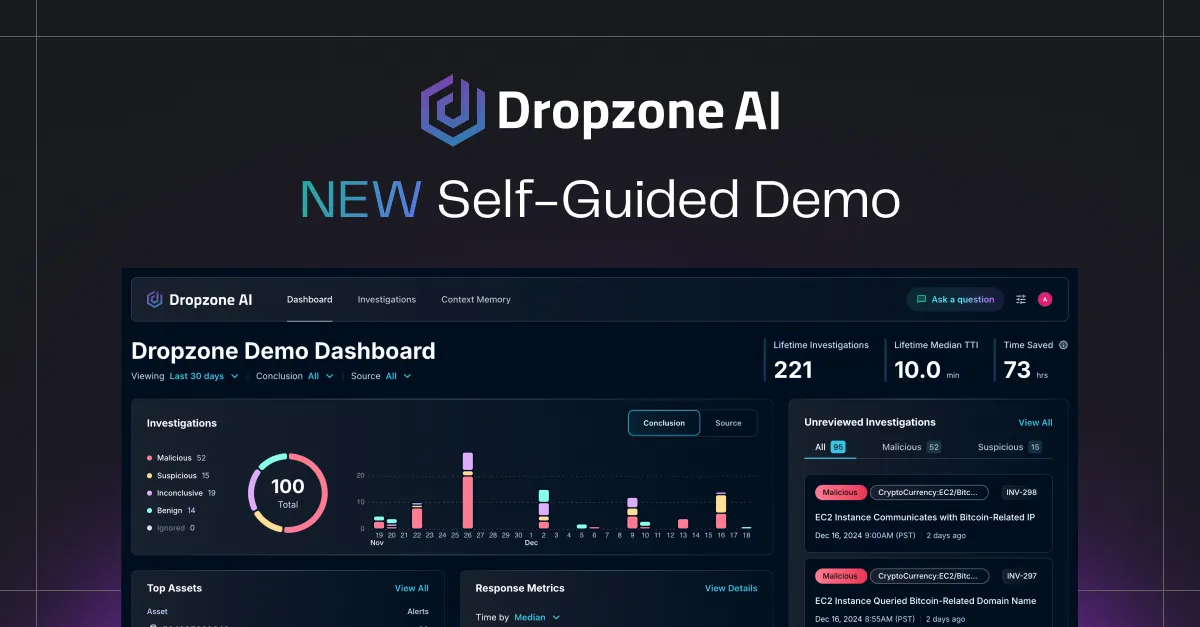
If you are weighing the move, start with how to evaluate an AI SOC analyst Then watch one work. Take the self-guided demo or request a demo to see the AI SOC Analyst investigate alerts end to end.








.png)