

Your queue didn't empty last night, and it got worse at shift change. Nobody on the team did anything wrong. There are only so many analyst hours in a day, and the alerts don't stop when the hours do.
The agentic SOC changes that, so coverage no longer depends on how many hours your team has.
What is an agentic SOC?
An agentic SOC is a way of running security operations, not a product. In this model, AI agents do the hands-on work across the SOC's core functions, pass work to each other without waiting on a person, and bring your analysts the cases that need a human decision, with the evidence already pulled together.
Dropzone AI, which builds the agents that run this model, puts it this way. The agents do the work, and the analysts make the decisions. Three things define the model, and all three have to be true at once:
- The agents cover the whole loop, not one task. Threat intel, threat hunting and investigation each produce something the others need. The agents pass that along to each other, so what intel learns shapes what hunting looks for, and what a hunt finds changes what investigation checks.
- Work arrives as findings, not alerts. A finding tells you what happened, with the evidence and the reasoning laid out, so your analyst checks the work and makes the call instead of redoing the investigation.
- People make the final call and set the limits. Your team decides what the agents can do autonomously, where they stop and ask a person for more context, and what always needs a human decision. The audit trail shows every action stayed inside those limits.
Gartner's definition in the Hype Cycle for Security Operations, 2026 points the same way. AI SOC agent solutions "use AI to help augment many of the common activities found within security operations." Augment is the key word. Analysts stay involved in every case, but the work no longer sits and waits for an analyst to be free.
You can see the gap in the numbers. The 2026 SANS SOC Survey found that 79 percent of respondents use AI or ML tools, but only 36 percent have built them into a defined SOC workflow. Most SOCs already have AI somewhere, and few have changed how the SOC runs around it.
What does "agentic" mean in a security context?
Agentic software can look at what's in front of it, reason about it, plan the next steps and carry them out on its own within the limits you've set, instead of waiting for someone to tell it what to do at each step.
In a SOC, that means an agent can take an alert, form a theory about what happened, check the SIEM (security information and event management), the endpoint tool and the identity provider, weigh what it finds, and either deliver a verdict with the evidence or escalate it with a recommended next step.
The technology behind that, and how it differs from generative and rule-based AI, is covered in our agentic AI explainer.
What changes when a SOC runs on this model?
The way most SOCs run has been under strain for twenty years. Coverage depends on how many analyst hours you have, alerts get worked in whatever order someone can get to them, and what the team learns lives in the heads of whoever's on shift. That setup was maxed out before AI came along.
Most improvements since then have tried to squeeze more out of that setup. Better detections so fewer alerts reach a person, better tuning so the queue is shorter, better runbooks so each step takes less time. All of it helps, and all of it runs into the same wall. When the hours run out, coverage stops.
The agentic SOC changes the setup itself. Eight things change.
You can't buy any one of these eight as a feature.
How is an agentic SOC different from automation and SOAR?
Every SOC already automates something, so the useful distinction is who does the investigating and who reviews the result.
SOAR, meaning security orchestration, automation and response, isn't a column in that table, because it's a tool rather than a way of running the SOC. A SOAR platform runs the repeatable responses you wrote a playbook for, and it does that job in all three models.
Where does SOAR fit in an agentic SOC?
Right where it's always been, running the repeatable, pre-written responses. What SOAR can't do is investigate an alert nobody wrote a playbook for, because a playbook only covers what someone planned for in advance.
The agents do that investigation, reach a verdict with evidence, and hand the response to whichever mechanism the team has chosen, a playbook included. One runs the plan. The other figures out what happened.
What do the AI agents do, and what stays with people?
Every SOC answers the same four questions, shift after shift. Which threats matter? What are we missing? What happened? What do we do next? In an agentic SOC, each question has an agent working on it around the clock, and the agents share what they learn with each other:
- Know what threats matter. The AI Threat Intel Analyst, in production today, reads new advisories, pulls out what applies to your environment, and hands the AI Threat Hunter ready-to-run hunt packs.
- Know what you're missing. The AI Threat Hunter, also in production, runs hypothesis-driven hunts across your SIEM, endpoint and cloud data every shift. Detection engineering is next.
- Know what happened. The AI SOC Analyst is generally available. It investigates every alert end to end and returns a verdict with the evidence and a guided remediation plan.
- Know what to do next. On threats the agents have confirmed, auto-containment fires immediately, blocking malicious IPs and disabling compromised accounts. The agents that will handle the rest of response, an Incident Analyst and an AI Resilience Engineer, are coming next.
Who owns the verdict?
Your analysts do, on every alert. Each finding shows the full chain of reasoning, so an analyst can follow how the agent got there and either agree or correct it. The correction sticks, and the agents apply it next time, so what one analyst knows about your environment becomes something the whole team benefits from.
What do the agents not do?
They don't take actions outside the limits you've set, and the audit trail shows where they stopped and handed off. Today, containment stops at blocking malicious IPs and disabling compromised accounts on confirmed threats. The agents don't take any other action on their own.
The value is in the alerts that weren't getting investigated at all, not in beating a perfect analyst with unlimited hours.
What happens to the analyst role in an agentic SOC?
It moves up to the decisions. When the agents cover the whole environment instead of the slice your team had time for, more real decisions come up, not fewer. The hunt that never got run finds something. The advisory nobody had time to act on turns out to matter.
Someone also has to set those limits and widen them as the agents earn trust. And when an analyst corrects a verdict or explains what's normal in this environment, that knowledge stays with the team instead of walking out the door when the analyst does.
What that looks like in practice is the same team covering far more:
- Zapier runs 85 percent less manual alert investigation with a three-person team.
- ECS, a top-five MSSP (managed security service provider) in North America, scaled to more than 30,000 alerts a month with no added headcount.
- CBTS documented more than $1 million in analytical capacity redeployed.
How do you evaluate an agentic SOC vendor?
Plenty of platforms now ship with multiple agents, so counting agents won't tell you much. Ask every vendor the same four questions:
- Does it keep pace? Work advances without waiting on a person to be free. Ask what happens to an alert at 3 a.m. on a Sunday, step by step.
- Does it stay inside the limits you set? You decide where the agents stop and ask for a person. Ask to see the controls, and the audit trail they leave behind.
- Does it show its work? Every finding arrives with reasoning. Ask to trace one verdict back through the evidence yourself.
- Does it hold up months later? Someone can ask what ran and why, long after the fact. Ask how a correction made in March changes an investigation in August.
Gartner's guidance to security leaders in the 2026 Hype Cycle is to be "highly cautious of 'GenAI washing' and unproven autonomous capabilities" and to pilot rigorously. That guidance works in your favor. A vendor who's happy to run a pilot on your alerts, with your limits in place, is showing you something a demo can't.
What should a pilot prove on your own alerts?
The agents reach verdicts you can defend on your real alerts, including the ones your team would have closed on pattern. The reasoning holds up when your best analyst picks it apart. And a correction your team makes shows up the next time a similar alert comes in.
What does the model look like in practice?
Dropzone AI runs the agentic SOC model across 300+ deployments. Three agents are in production today, the AI SOC Analyst, the AI Threat Hunter and the AI Threat Intel Analyst. Every finding is open for your analysts to review and steer, and you set the limits.
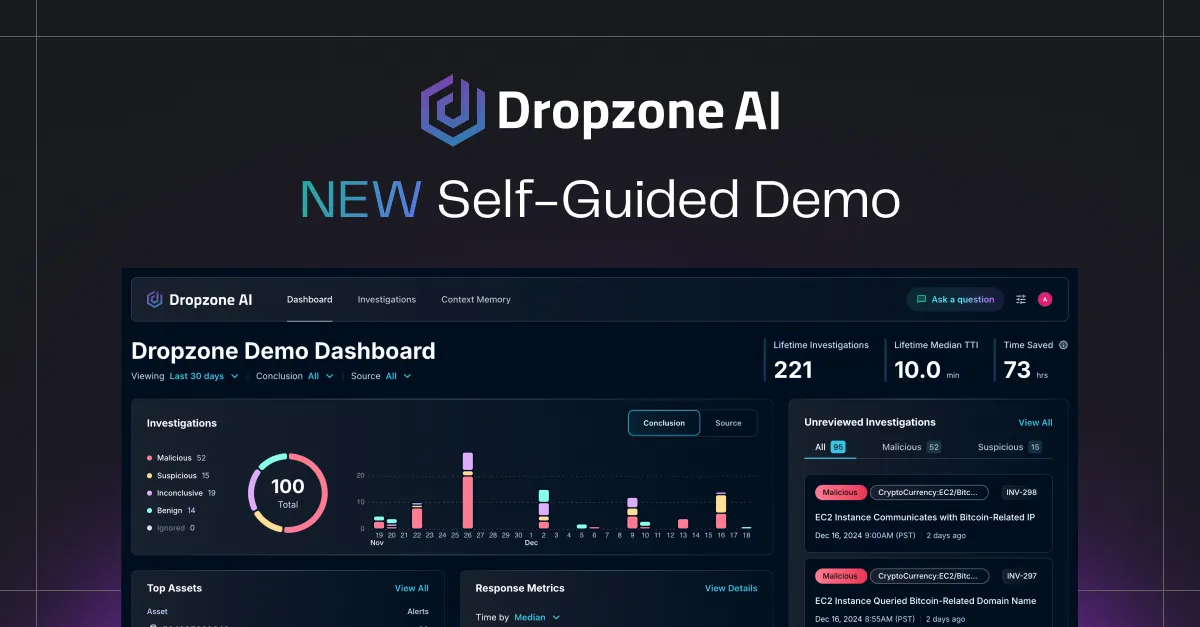
Gartner named Dropzone AI a Sample Vendor in the AI SOC Agents category of its 2026 Hype Cycle for Security Operations. If you'd rather see it than read about it, the self-guided demo lets you watch the agents investigate real alerts in ten to fifteen minutes, and there's nothing to set up.
Key takeaways
- An agentic SOC is an operating model, defined by who does the work and how it reaches your analysts, not by how many agents a vendor ships.
- Eight things change when a SOC runs on it, from coverage limited by analyst hours to coverage that runs around the clock, and from work arriving as alerts to work arriving as findings.
- People make the final call and set the limits. The agents do the work, your analysts make the calls, and their corrections stick.
- Evaluate on four questions, and insist on a pilot on your own alerts.
.jpg)








.png)