

For years, Security Operations Centers (SOCs) have operated under a difficult compromise: move fast or be thorough, but never both. Every analyst knows the tension.
On the other side lies the demand for depth: investigations must be exhaustive enough to avoid false negatives, ensuring no real threat slips through simply because someone didn't dig deep enough.
Traditional SOC workflows and tools force this tradeoff. Analysts face an impossible choice:
- Rush through alerts to keep queues manageable, risking missed context and incomplete findings
- Dive deep into every signal, creating latency that attackers can exploit while other alerts wait
- Accept the zero-sum game where gains in speed always mean losses in thoroughness
The result is a reactive cycle where no approach truly succeeds.This isn't just a workflow problem. It's an operational mindset that's long been accepted as inevitable. But it doesn't have to be.
The emergence of AI SOC analysts, such as Dropzone AI, is proving that speed and thoroughness no longer need to compete. By investigating alerts autonomously and reasoning recursively, Dropzone can operate at machine speed while maintaining the rigor needed.
It's not about choosing between velocity and visibility anymore. It's about achieving both consistently, without compromise.
Why Is Latency the Biggest Hidden Threat in SOC Operations?
Security alert latency costs organizations an average of 3-5 hours per incident in delayed response time. During this window, attackers move laterally, escalate privileges, and exfiltrate data while alerts sit unacknowledged in queues, making latency the primary factor inflating MTTR before investigations even begin.
In security operations, time isn't just a metric. It's the difference between control and compromise. Every second an alert sits unacknowledged is a second an attacker can:
- Move laterally across the network undetected
- Escalate privileges to access critical systems
- Exfiltrate sensitive data before containment
- Establish persistence mechanisms for future access
- Cover their tracks by deleting logs and evidence
Yet for most SOCs, this delay is built into the system. The bottleneck doesn't start during the investigation. It starts long before, in the queue.
Manual triage, false positives, and overwhelming alert volume mean that alerts often wait hours before an analyst even opens them. By then, the damage may already be done.
These delays quietly inflate MTTR more than any other factor. Analysts, buried under endless notifications, must constantly make quick judgment calls addressing what appears most urgent instead of what's most consequential.
This reactive cycle creates multiple failure points:
- Alert fatigue reduces analyst effectiveness over time
- Context switching between alerts wastes cognitive resources
- Prioritization errors bury genuine threats beneath noise
- Investigation delays allow attackers wider operational windows
- Analyst burnout compounds staffing challenges
The problem isn't that analysts aren't capable; it's that time simply doesn't scale with the increasing number of alerts.
This is where Dropzone changes the equation. Its AI SOC analyst begins investigating the moment an alert arrives, with no waiting and no backlog.
What once took hours to acknowledge now takes seconds. By cutting Mean Time to Acknowledge (MTTA) to near zero, Dropzone eliminates the dead time that attackers rely on. It ensures that every alert is not only seen but acted on instantly, transforming response speed from a weakness into a strategic advantage.
Read how Dropzone AI cuts MTTR to under 10 minutes.
What Happens When SOCs Prioritize Speed Over Thoroughness?
SOC analysts that are honest will acknowledge the pressure to close alerts fast—or just summarily dismiss entire groups of low-priority alerts out of hand.
But speed without depth creates risk that compounds over time. SOCs that rush through investigations close alerts quickly but miss critical details, with each half-baked investigation adding a little extra risk to the organization. Each overlooked anomaly becomes a potential seed for future data breach with root causes remaining unaddressed.
This "fast but shallow" approach often feels productive in the moment, as alerts are closed, and dashboards look cleaner. However, beneath the surface, critical details go unnoticed.
The consequences of rushed investigations include:
- Missed root causes that allow threats to persist undetected
- False closures that create a false sense of security
- Incomplete remediation that leaves vulnerabilities exploitable
- Pattern blindness where related incidents appear unconnected
- Added risk that compounds with each overlooked detail
Missed root causes lead to recurring incidents, false closures, and a growing sense of déjà vu in the SOC. Each overlooked anomaly becomes a seed for future compromise, creating risk that compounds over time.
Efficiency, in this context, becomes a mirage. SOCs may appear to be moving faster, but they're really just circling the same problems again and again.True efficiency isn't about taking shortcuts; it's about doing fast work that's also thorough. That balance of speed without sacrificing substance is what separates a reactive SOC from a resilient one.
Dropzone's AI SOC Analyst is built around that principle, ensuring investigations are not only immediate but also complete. It doesn't rush to close alerts; it reasons through them, gathering context and evidence to deliver conclusions analysts can trust.
The result is a workflow that's as quick as it is dependable, one that drives lasting security outcomes instead of temporary relief.
How Does Dropzone AI Achieve Both Speed and Depth?
Dropzone AI combines machine-speed execution with human-level investigative rigor through recursive reasoning and context memory. Every investigation begins instantly upon alert arrival and dynamically adapts based on evidence discovered, querying SIEM, EDR, and identity systems while building context from previous investigations to distinguish genuine threats from normal business activity—all completed in 3-10 minutes versus 20-40 minutes manually.
This is where Dropzone AI redefines what efficiency truly means. AI SOC Analysts don't just move fast, they think fast. Every investigation begins the instant an alert arrives, but instead of following a static checklist or a playbook, Dropzone builds a plan based on the proven OSCAR investigative methodology.
Dropzone's investigation methodology includes:
- Recursive reasoning that adapts as new evidence emerges
- Dynamic investigation planning based on alert context and findings
- Multi-source correlation across SIEM, EDR, and identity systems
- Contextual memory that remembers previous investigations and user patterns
- Evidence chain documentation showing exactly how conclusions were reached
- Real-time adaptation when initial hypotheses require refinement
Through recursive reasoning, it adapts as it learns more, asking follow-up questions, gathering context, and connecting evidence from multiple sources, whether that's your SIEM, EDR, or identity systems. The result is an investigation that feels human in its depth but operates at machine speed.
Dropzone's contextual memory ensures that nothing happens in isolation. It remembers previous investigations, user behaviors, and patterns across your environment, enabling it to distinguish between genuine threats and normal business activity.
Every conclusion it reaches is supported by transparent evidence and structured reasoning, providing analysts with complete visibility into how a decision was made.
The outcome is a balance that traditional SOCs have struggled to achieve: speed without compromise. Key performance indicators include:
- 3-10 minute investigations versus 20-40 minutes manual
- 100% alert coverage with no backlog or queue delays
- 99.9% accuracy in threat classification and prioritization
- 24/7 consistent performance regardless of time or analyst availability
- Zero playbook maintenance required as AI adapts autonomously
Investigations that once took hours are now completed in minutes, yet with a level of depth and accuracy that analysts can trust.
And because Dropzone never sleeps, this standard of thorough, real-time investigation applies equally well at 2 p.m. or 2 a.m., ensuring that threats are addressed with both precision and immediacy, 24/7.
Read how Mysten Labs reduced manual alert investigation workload by 99%.
What Role Do Human Analysts Play in AI Investigations?
Human analysts remain the ultimate arbiters of truth, bringing nuance and contextual understanding that only experience provides. Dropzone's human-in-the-loop oversight enables analysts to review AI reasoning, validate conclusions, and trace evidence behind every finding—creating a feedback loop where analyst corrections refine the system's understanding while maintaining the perfect balance between automation's tireless efficiency and human accountability.
Even with all its speed and precision, Dropzone doesn't remove the human element. It amplifies it. Human analysts remain the ultimate arbiters of truth in any investigation, bringing nuance, intuition, and contextual understanding that only experience can provide.
Dropzone was built to work in tandem with that expertise, not to replace it.
The human-AI partnership model includes:
- Complete transparency into AI reasoning and evidence chains
- Analyst validation of conclusions before actions are taken
- Feedback loops where corrections improve AI accuracy over time
- Escalation workflows for complex or ambiguous scenarios
- Context preservation ensuring organizational knowledge guides decisions
- Audit trails documenting both AI analysis and human oversight
Through human-in-the-loop oversight, analysts can review the AI's reasoning, validate conclusions, and trace the evidence behind every finding. This transparency not only builds trust in the results but also creates a feedback loop that continually sharpens the system's understanding of each organization's unique environment.
When analysts correct or clarify an outcome, Dropzone learns from that guidance and instruction, becoming even more attuned to the realities of the business it protects.
This partnership delivers several critical advantages:
- No alert goes uninvestigated due to AI's tireless operation
- Every conclusion is reviewable maintaining human accountability
- Investigation quality improves through continuous learning
- Analyst expertise scales beyond individual capacity limitations
- Trust and transparency coexist with automation efficiency
This partnership of AI's tireless efficiency, combined with human discernment, strikes the perfect balance between automation and accountability. The AI ensures no alert goes uninvestigated, while human oversight ensures that every conclusion stands up to scrutiny.
What Measurable Results Do SOCs See with Dropzone AI?
Organizations using Dropzone AI achieve MTTA reduced from hours to seconds, MTTR decreased by 85-90%, and 100% alert investigation coverage without adding headcount. Every investigation follows a structured reasoning process that eliminates variability from analyst experience or fatigue, maintaining consistent depth and accuracy whether processing the first alert of the morning or the thousandth of the day.
The results speak for themselves. When Dropzone enters a SOC, the impact is measurable. Metrics that once seemed locked in place begin to shift dramatically.
Key performance improvements include:
Time Metrics:
- MTTA reduction: From hours to seconds (near-zero acknowledgment delay)
- MTTR improvement: 85-90% decrease in time to resolution
- Investigation speed: 3-10 minutes versus 20-40 minutes manual
- Response acceleration: Decision-ready reports eliminate data gathering and analysis delays
Coverage Metrics:
- 100% alert investigation: Every alert receives thorough analysis
- Zero backlog: No queues or delayed investigations
- 24/7 operation: Consistent performance regardless of time or staffing
- Scalability: Handles alert volume growth without headcount increases
Quality Metrics:
- 99.9% accuracy: In threat classification and prioritization
- Consistent methodology: Structured reasoning eliminates variability
- Complete documentation: Full evidence chains for every investigation
- Reduced false positives: Context-aware analysis improves signal-to-noise ratio
MTTA, often stretched by hours of alert backlogs, collapses to mere seconds as investigations begin the instant an alert arrives. MTTR follows suit, shortened by decision-ready reports that provide full context and clear next steps without the usual delays in data gathering or correlation.
Consistency also becomes the new standard. Every investigation follows a structured reasoning process, eliminating the variability that naturally arises from differing levels of analyst experience or fatigue.
Whether it's the first alert of the morning or the thousandth of the day, Dropzone ensures the same depth, accuracy, and transparency every single time. And because the AI operates continuously, the SOC's coverage expands exponentially. Every alert gets investigated with no exceptions, no backlogs, no compromise.
With Dropzone, the SOC no longer has to choose between velocity and vigilance. It achieves both, effortlessly.
Can Modern SOCs Finally Eliminate the Speed vs. Quality Tradeoff?
Yes. Dropzone AI proves that precision at speed is achievable through autonomous investigation that combines immediate response with meticulous analysis. The future SOC doesn't have to compromise between quality and speed; it expects both, and Dropzone makes that expectation a reality.
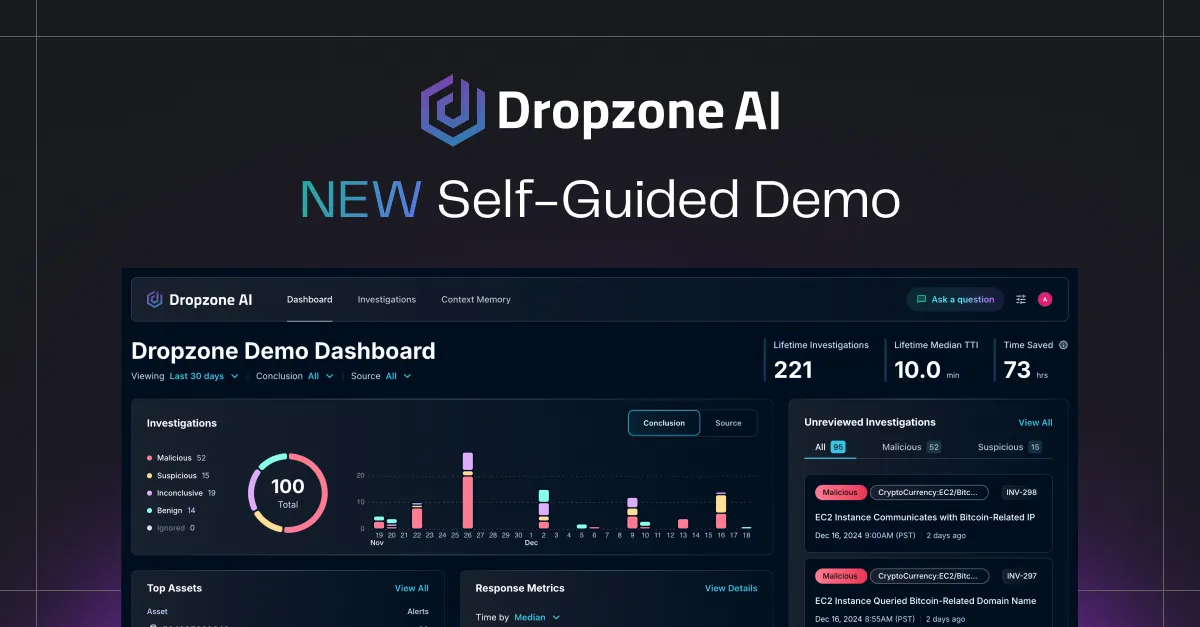
Try Dropzone now with our self-guided demo. It’s a real environment that you can explore.
Or if you’re ready to talk, book a demo and experience what it means to investigate without compromise.










.png)